Why this book?
- It defines a clear and useful concept, "capitalist realism," that makes it easier to analyze today's culture and politics.
- It presents the 2008 banking crisis and the bank bailouts as an example of this ideology at work.
- With the concept of "reflexive impotence," it explains why people know capitalism's flaws and still feel unable to act.
- It reveals the links between neoliberalism, bureaucracy, education and mental illness.
- Rather than relying on utopias, it directs critique to the system's own points of failure, such as climate change and mental health.
About the book
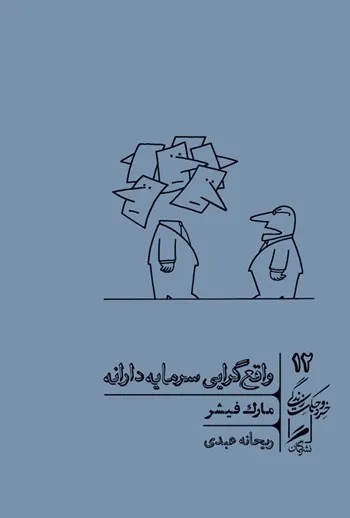
Capitalist Realism by Mark Fisher, the British theorist and cultural critic, was first published in 2009 and has been translated into Persian by Reyhaneh Abdi. Gamān Publishing has issued the translation. The original subtitle, "Is There No Alternative?", alludes to Margaret Thatcher's slogan "There is no alternative."
Fisher, with a nod to the term "socialist realism," defines "capitalist realism" as a pervasive sense that capitalism is the only viable political and economic system and that even imagining a coherent alternative to it has become impossible. He sees this sense not as confined to art and advertising but as an atmosphere that conditions the production of culture, the regulation of work and education, and hangs over thought and action like an invisible barrier. His examples in the book include the film Children of Men and the 2008 banking crisis, in which the state, whose shrinking neoliberal ideologues had long called for, moved swiftly to rescue the banking system.
Among the book's other concepts is "reflexive impotence," a condition in which people know capitalism's flaws but believe there is no way to change it. Fisher also speaks of "business ontology," a logic that understands goals solely in business terms and spreads into education and public services. To critique this ideology, he draws on Jacques Lacan's distinction between the Real and ideological "realities," and he identifies climate change, mental health and bureaucracy as places where the gaps in this narrative become visible.