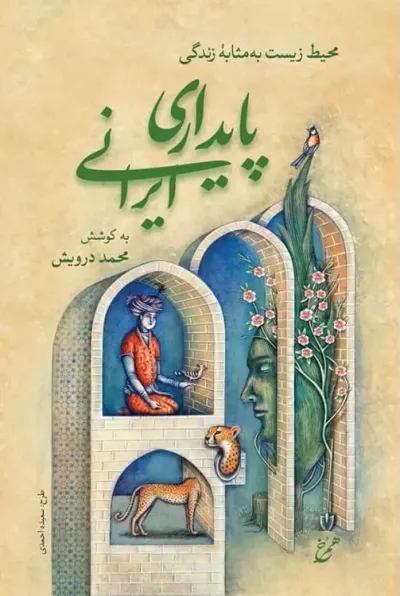
Why this book?
- It offers an interdisciplinary perspective on sustainability and Iran’s future.
- It brings together specialists in fields including economics, sociology, water, energy, agriculture and ecology.
- It examines the links between environmental crises and models of development in Iran from multiple perspectives.
- Alongside specialist analysis, it reflects the lived experiences of environmental activists.
- It is a useful starting point for readers seeking a multidimensional picture of Iran’s environmental challenges.
About the book
“Iranian Sustainability: The Environment as Life” is a collection of essays by scholars, researchers and activists from a range of fields, compiled and edited by Mohammad Darvish. The collection’s central question can be framed as follows: how should Iran’s sustainability be understood, and what kinds of knowledge are needed to confront the country’s environmental and developmental crises?
The book does not approach this question from a single perspective. Its essays are organised into sections including “Outlook,” “Sustainable Development” and “Lived Experience,” with contributors from economics, sociology, biology, botany, agriculture, water and energy engineering, tourism and ecology. Issues such as biocapacity, energy waste, agriculture, environmental economics, ecological crisis, waste management and the relationship between education and the environment each contribute to the book’s broader picture.
Mohammad Darvish’s role in this work is less that of the author of a single-voiced book than that of an editor bringing different voices and areas of expertise together around a shared concern: Iran and the possibility of its sustainability. In this sense, the collaborative form of the book itself reflects its central idea: understanding a complex issue such as sustainability requires dialogue across disciplines and the combination of specialist knowledge with practical experience.