Why this book?
- To become acquainted with Katouzian's theory of state and society in Iran.
- To understand the cycle of arbitrary rule, chaos, and the return of centralized power.
- To read a comparative analysis of the differences between the historical experiences of Iran and Europe.
- To learn about the theoretical roots of discussions such as constitutionalism, freedom, and democracy in Iran.
About the book
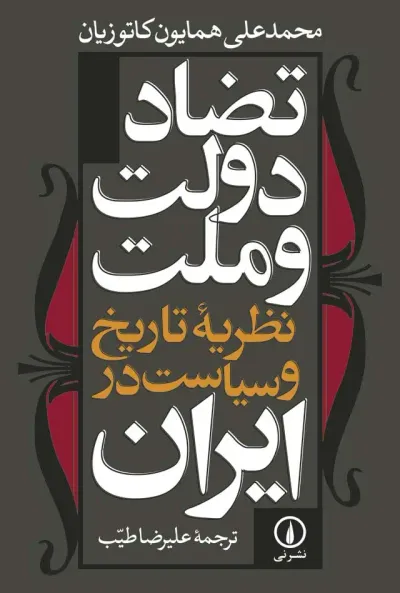
"The State and Society in Iran," subtitled "A Theory of History and Politics in Iran," is a collection of independent yet interconnected articles by Mohammad Ali Homayoun Katouzian. The common thread of these articles is explaining the tense relationship between state and society in Iranian history and examining patterns that, in the author's view, distinguish Iran's political history from the European experience.
In this book, Katouzian tests the theory of arbitrary rule and the short-term society in various contexts. He demonstrates that in Iran, unlike many European societies, the state was often not the representative of a stable class or an established legal order, and political power rested more on the will of the ruler and the possibility of sudden collapse. It is from this that the cycle of "arbitrary rule – chaos – arbitrary rule" gains importance in his analysis.
The book addresses topics such as Iranian revolutions, the Constitutional Revolution, divine grace (farr-e izadi) and the divine right of kings, European liberalism, concepts of freedom in Iran, democracy, the public sphere, the Pahlavi regime, and the financial history of Iran. This thematic diversity allows the reader to become acquainted with Katouzian's intellectual system regarding history, politics, state, and society in Iran.
This work is suitable for those interested in political science, Iranian history, historical sociology, and contemporary Iranian studies; especially for those who wish to go beyond the narrative of events and become familiar with a theoretical framework for understanding the continuities and ruptures of Iranian politics.