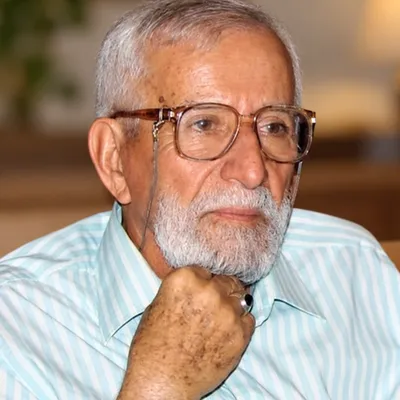
Iranian thinker
Ahang Kowsar
Ahang KowsarAquifer management and water resource managementIranianb. 1936
What this long tongue of mine wishes to claim is this: not everything cheap is bad. Artificially recharging aquifers is a wise, easy, and inexpensive undertaking, and, most importantly, environmentally far less costly than large dams.

Life and Thought
Seyyed Ahang Kowsar is an Iranian researcher and the founder of the modern science of "aquifer management" (artificial groundwater recharge) in Iran, who, through Iran's first aquifer management project in Gerbayegan, Fasa, starting in 1984, became known as "the father of Iran's modern science of aquifer management." In 2005 he received UNESCO's prestigious water prize in Budapest.
Seyyed Ahang Kowsar was born on May 25, 1936, and hails from Fars province. He pursued his graduate studies in the United States, earning a doctorate in water-soil-plant relations, with a specialization in irrigation engineering and forest hydrology, from a university in Oregon.
Kowsar began his research work in 1972 studying floodwater spreading at the Nodehak station in Qazvin, continuing from late 1979 in Jowngan, Mamasani, Fars. From 1984 onward he implemented "Aquifer Management" projects in the Gerbayegan region of Fasa and other mainly central areas of Iran — a method based on directing and storing floodwater runoff in underground aquifers rather than building reservoir dams. He first formulated the philosophy of aquifer management on August 29, 1994, at the Fourth Soil Science Congress at Isfahan University of Technology.
For years, Kowsar lived alongside his fellow aquifer-management practitioners in a container in the deserts of Gerbayegan, Fasa, and was a vocal critic of the structural approach to water management in Iran, particularly the construction of large reservoir dams. He argued that in a country with an average annual evaporation exceeding two meters, artificial recharge of coarse-grained aquifers — feasible across roughly 14 million hectares of Iranian soil — is a cheaper, more sustainable, and environmentally less costly method than large dams.
On November 10, 2005, at a World Science Day ceremony in Budapest, Hungary, Kowsar received UNESCO's top water prize from then Director-General Koïchiro Matsuura. His other honors include the Best Watershed Management Paper Award (1993), the Third-Degree Research Medal (1996), the Khwarizmi Second Prize (1996), the World Intellectual Property Gold Medal (1996), the National Environment Award (2000), and international prizes from the UN Human Settlements Programme in Dubai (2004) and from UNESCO for great man-made rivers (2005). His aquifer management method has also been endorsed by the UN Food and Agriculture Organization (FAO) as an approach to combating global hunger.