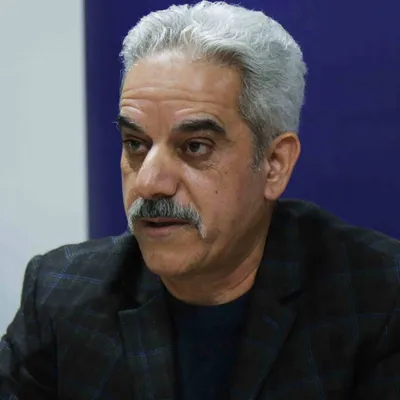
Iranian thinker
Dariush Rahmanian
Dariush RahmanianModern Iranian History, Historiography, and Philosophy of HistoryIranianb. 1965
Life and Thought
Dariush Rahmanian is an Iranian historian, Associate Professor in the Department of History at the University of Tehran, and a scholar of modern Iranian history, historiography, and the theoretical study of history. He is the managing director and editor-in-chief of the quarterly journal Mardom-Nameh, and his work addresses the Constitutional Revolution, political thought in the Qajar period, the problem of decline and backwardness, and people’s history.
Dariush Rahmanian Koushkaki was born in Borujerd in 1965. He completed his bachelor’s degree in history at the University of Tabriz, pursued a master’s degree at Shahid Beheshti University, and returned to the University of Tabriz for his doctorate in history. He received these degrees in 1989, 1993, and 2002, respectively. Rahmanian subsequently joined the Department of History at the University of Tehran, where he has devoted most of his academic career to teaching and research.
His research encompasses modern Iranian history, the history of political thought, social and cultural history, philosophy of history, historical methodology, and historiography. One enduring theme in his work is the inquiry into the causes of decline and backwardness among Iranians and Muslims, a subject developed in his academic dissertation and subsequent writings. He has also published studies of the Qajar period, the Constitutional Revolution, and Iran’s political and social transformations in the twentieth century.
Rahmanian’s major works include A History of Explanations of the Decline and Backwardness of Iranians and Muslims, The Contest Between Republic and Monarchy in Iran, A History of Political Thought in the Qajar Period, The Constitutional Movement, and Iran Between Two Coups. He has also published works on philosophy of history, methodology, and historiography. Iran Between Two Coups examines Iran’s political, social, economic, and cultural transformations from the fall of the Qajar dynasty to the coup of 19 August 1953, while his theoretical writings address the foundations and methods of historical knowledge.
Another important part of Rahmanian’s intellectual activity is connected with the quarterly journal Mardom-Nameh, of which he is the managing director and editor-in-chief. The journal focuses on people’s history and less visible aspects of social life. This approach stands against forms of historiography that confine narratives of the past chiefly to states, political elites, and prominent figures, seeking instead to make the experiences of diverse social groups a subject of historical inquiry.
Rahmanian’s intellectual project can be understood as joining empirical research into modern Iranian history with theoretical reflection on how history is written and understood. His attention to constitutionalism, backwardness, people’s history, and the critique of state-centered and great-person narratives forms part of a common concern: how Iranian society narrates its past and what role historical consciousness plays in understanding its present.