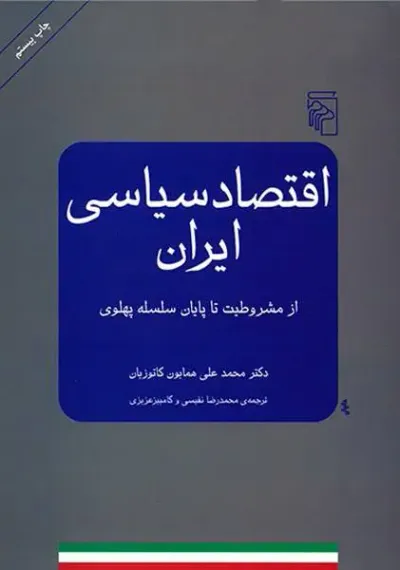
Why this book?
- To understand the relationship between the economy and political power in modern Iranian history.
- To become familiar with the theory of Iranian despotism and the short-term society.
- To examine Iran’s transformations from the Constitutional Revolution to the 1979 Revolution within a single analytical framework.
- To understand the role of oil, the state, and land reform in the political economy of the Pahlavi era.
- For readers of history, economics, political sociology, and Iranian studies.
About the book
The Political Economy of Iran is one of Homa Katouzian’s important works on modern Iranian history. The book seeks not to treat Iran’s economic transformations apart from politics and society, and shows that the question of development in Iran is tied to the structure of the state, despotism, crises of legitimacy, and historical instability.
The book begins with the Constitutional Revolution and moves forward to the end of the Pahlavi dynasty. In its main sections, Katouzian first discusses the state and revolution, the historical background of the nineteenth century, and the Constitutional Revolution; he then examines the formation of the Pahlavi pseudo-modern state, the interregnum and the National Movement, and finally oil despotism and the economic and political crises of the final decades of Pahlavi rule.
The book’s importance lies in reading Iran’s economic history through Katouzian’s distinctive theoretical framework, associated with concepts such as Iranian despotism, the arid and isolated society, the supra-class state, and the short-term society. From this perspective, Iran’s economy is not merely a set of statistics and fiscal policies, but part of the history of power, law, property, and the relationship between state and society.