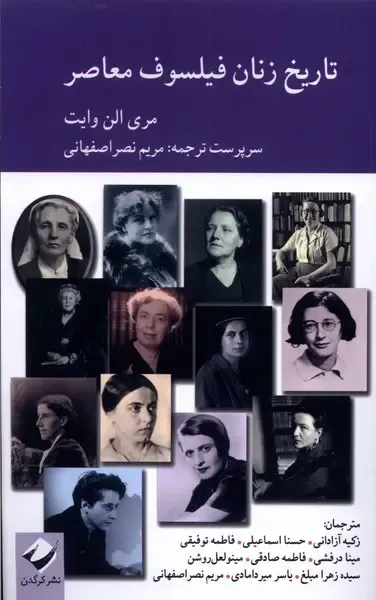
Why this book?
- To become acquainted with the role of women in contemporary philosophy.
- To learn about philosophers who have been less visible in mainstream historiography of philosophy.
- To study the lives and works of figures such as Hannah Arendt, Simone de Beauvoir, and Simone Weil.
- To understand the relationship between philosophy, academic education, and gender discrimination in the twentieth century.
- For readers interested in the history of philosophy, women's studies, and contemporary philosophy.
About the book
A History of Women Philosophers: Contemporary Women Philosophers, written by Mary Ellen Waithe and translated by Maryam Nasr Esfahani, is the fourth volume in the "History of Women Philosophers" series. The book turns to women who, at the beginning of the twentieth century, still faced serious obstacles to entering formal philosophical education, but gradually managed to enter universities, professional associations, and the academic sphere of philosophy.
The book's significance lies in its rereading of the history of philosophy from a less-seen angle. The authors show that contemporary women philosophers were not merely on the margins of philosophical thought, but played a role in posing major questions, training students, writing influential works, and shaping academic discussions. From this perspective, the book is both a history of thought and a critique of the methods of exclusion and erasure in mainstream narratives of philosophy.
The book's structure is based on introducing and analyzing the lives, works, and intellectual systems of thirteen women philosophers; from Victoria Lady Welby and Mary Whiton Calkins to Edith Stein, Ayn Rand, Hannah Arendt, Simone de Beauvoir, and Simone Weil. This diversity shows that contemporary women philosophers have been present in fields such as logic, ethics, political philosophy, existentialism, phenomenology, theology, feminism, and cultural criticism.