Why this book?
- To understand Aristotle’s place in the formation of the young Heidegger’s thought.
- To explore the meaning of logos beyond its conventional, exclusively logical interpretation.
- To examine the relation of logos to motion, phenomenology, theory, and action in Heidegger’s reading of Aristotle.
- To understand Heidegger’s hermeneutic engagement with one of the founders of the metaphysical tradition.
- To study an academic work situated at the intersection of Aristotle studies, Heidegger studies, and phenomenology.
About the book
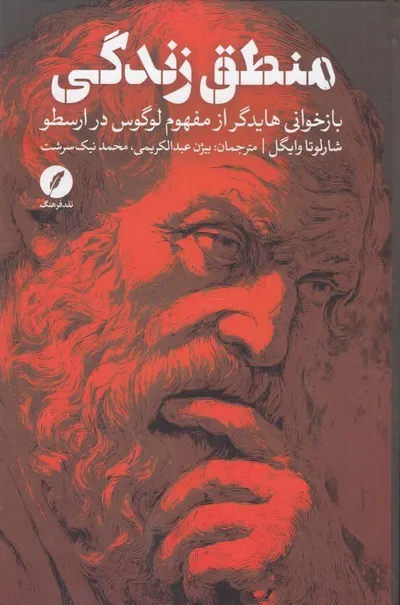
The Logic of Life: Heidegger’s Retrieval of Aristotle’s Concept of Logos originated as Charlotta Weigelt’s doctoral dissertation, submitted to Stockholm University in 2002 and published in the Stockholm Studies in Philosophy series. The study examines Martin Heidegger’s reading of Aristotle’s concept of logos and stands at the intersection of Aristotle studies, Heidegger studies, and phenomenology.
The book’s central problem arises from Heidegger’s concern with the “beginning” of philosophy. For Heidegger, thought cannot remain indifferent to its own history or to philosophy’s Greek beginning; consequently, the effort to prepare a new beginning for philosophy requires a renewed engagement with Aristotle. Weigelt traces this engagement through the concept of logos, showing that Heidegger’s interpretation is not merely a historical commentary on Aristotle but part of his attempt to reconsider the foundations of philosophy itself.
The inquiry extends beyond the meaning of logos to concepts such as motion, the facticity of life, phenomenology, teleology, proposition, theory, action, and everyday life. This conceptual network demonstrates why, in Heidegger’s reading, logos cannot be understood solely in the later sense of “logic” or as the formal structure of propositions. It must instead be examined in relation to modes of being, the disclosure of truth, and human activity.
The first chapter examines Heidegger’s philosophical project and its connection with Aristotle. The second considers epistemic logos and the components of propositional discourse, truth, synthesis, division, and apophansis. The third studies logos within everyday life, motion, action, and dialogue. The fourth addresses philosophical logos, the role of suspension, and the limits of dialectic, while the fifth traces the relation between logos and being through motion, change, unity, and temporality.
The book is significant because it challenges two familiar images at once: Aristotle as merely the founder of formal logic and Heidegger as a thinker who simply opposed the metaphysical tradition. In Weigelt’s account, Heidegger returns to the sources of that tradition in order to criticize and move beyond its legacy, seeking to retrieve possibilities in Aristotle’s thought that later philosophical history had obscured.
The Logic of Life is valuable for students and researchers working in continental philosophy, Heidegger, Aristotle, phenomenology, and hermeneutics. It offers a research-based account of how Heidegger turns the history of philosophy into a living philosophical problem by returning to the foundational texts of the tradition.
The principal aim of the present book is to examine the relation between logic and life on the basis of Heidegger’s interpretation of Aristotle’s philosophy, and to show Heidegger’s attempt to bridge the metaphysical divide between theory and practice through Aristotle’s understanding of the meaning and Greek concept of logos. According to Heidegger’s rereading of Aristotle, particularly in the logic lectures of 1925–1926, formal logic is not something merely formal and detached from life; rather, the foundation of logic must be sought in factical life itself, or in the facticity of life. For the young Heidegger, the concept of “factical life” possesses the same status and significance that the concepts of “world” and “being” acquire in the later stages of his thought. For Heidegger, life—or, in other words, being—is the most immediately accessible and concrete truth available to human consciousness.Author’s Introduction
From the table of contents
- 1Foreword
- 2Introduction
- 3Author’s Note on the Persian Translation
- 4Author’s Introduction
- 5Introducing Logos as the Center of Philosophical Work
- 6Aim and Structure of the Present Study
- 7Review of Previous Scholarship
- 8Chapter One: Heidegger’s Project and Its Connection with Aristotle
- 9The Philosophy of Factical Life
- 10The Philosophy of Logos: Phenomenology, Logic, and Hermeneutics
- 11Ontology and Teleology
- 12A Conception of First Philosophy
- 13Heidegger’s Critique of Ethics
- 14Philosophy as Historical Knowledge
- 15Historical Interpretation and Systematic Philosophy
- 16Chapter Two: Epistemic Logos
- 17On the Project of Questioning the Traditional Interpretation of Logos
- 18Synthesis and Division as the Principal Components of Propositional Discourse
- 19The Linguistic and Ontological Levels of Synthesis and Division
- 20The As-Structure
- 21Truth and Apophansis
- 22The Necessity of Contextualizing the Proposition
- 23Propositionality as Founded on a Transformation in Everyday Encounter
- 24The Moment of Reduction in Predicative Discourse
- 25The Problem of the Epistemic Ideal
- 26Concluding Remarks
- 27Chapter Three: Everyday Logos
- 28Everydayness as a Philosophical Topic
- 29Heidegger’s Reading of the Nicomachean Ethics
- 30Everyday Discourse as the Foundation of Aristotle’s Concept of Logos
- 31Technē and a Sense of Belonging: A Poetic Perspective on Everyday Life
- 32Phronēsis and Prohairesis
- 33The Discursive Character of Action
- 34Truth as the Dialogue of Nous
- 35Logos as Motion
- 36Logos as Fallenness and Idle Talk
- 37Concluding Remarks
- 38Chapter Four: Philosophical Logos
- 39Philosophy as an Authentic Possibility of Logos
- 40The Role of Suspension in the Emergence of Philosophy
- 41Transformation of Consciousness and Reduction
- 42The Limited Scope of Dialectic
- 43The Contemplative Life
- 44The Moment of Encountering Truth: Nous and the Moment of Vision
- 45Philosophy as Acting Against Habit and Repetition
- 46Formal Indication
- 47Concluding Remarks
- 48Chapter Five: Logos and Being
- 49From Logos to Being
- 50Being as Multiplicity and Unity: Aristotle’s Critique of the Eleatics
- 51The Principles of Change and Their Teleological Interpretation
- 52The Analysis of Change in Terms of Action and Passion
- 53The Common Foundation of Logos and Motion
- 54The Priority of the Proposition and the Question of Being
- 55The Question of the Meaning of Being: Logos as the Unity of Being
- 56Temporality as the Unity of Being
- 57Conclusion
- 58Bibliography
- 59Works by Heidegger
- 60Works by Aristotle
- 61Works by Other Authors