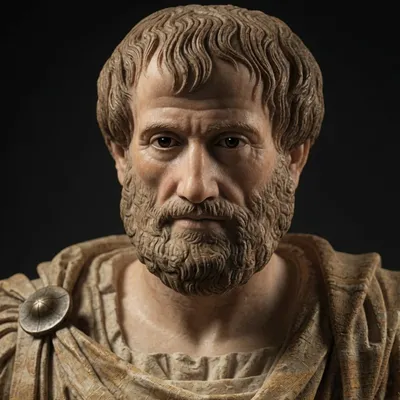
Foreign thinker
Aristotle
AristotlePhilosophyGreek384–322 BCE
We are what we repeatedly do. Excellence, then, is not an act, but a habit.





Life and Thought
Aristotle (384–322 BCE) was an ancient Greek philosopher and one of the most influential figures in the history of thought. He founded formal logic, and his works in philosophy, natural sciences, and ethics served as the foundation of education in the Greek, Islamic, and European worlds for centuries.
Aristotle (Aristotélēs), born in 384 and died in 322 BCE, was an ancient Greek philosopher and one of the most influential figures in the history of thought. He was born in Stagira in northern Greece and at the age of eighteen went to Plato's Academy in Athens. Aristotle spent about twenty years there learning, researching, and teaching, and later forged his own independent intellectual path, diverging from his teacher Plato.
After a period of travel and teaching, Aristotle served for a time as the tutor of Alexander the Great. He then returned to Athens and founded his own school, the Lyceum, which became a major center for research in philosophy, logic, biology, ethics, politics, literature, and the natural sciences.
Aristotle's importance lies in the breadth and systematic order of his thought. In logic, he established the first rigorous system of reasoning, and his works formed the basis of philosophical and scientific education in the Greek, Islamic, and European worlds for centuries. In ethics, he considered happiness (eudaimonia) the goal of human life and emphasized the cultivation of virtue through education and habit. In metaphysics, he reflected on being, substance, cause, matter, and form, and in the Poetics, he analyzed tragedy, narrative, and the effect of art.
Due to his foundational role in shaping philosophy and the sciences, Aristotle has been known in both the Islamic and European traditions as the "First Teacher." His thought continues to hold a central place in philosophy, logic, ethics, politics, literature, and the history of science.
Bibliography
Writings and transcribed lectures20 titles
Categories
Interpretations or Propositions
Prior Analytics
Posterior Analytics
Topica or Dialectics
Fallacies
Metaphysics
Nicomachean Ethics
Eudaemonist Ethics
Politics
On the Soul
Physics
About the Sky
On Generation and Corruption
Alavi's Works or the Science of the Universe of the Atmosphere
The History of Animals
On the Parts of Animals
On the Birth of Animals
Poetics
The Art of Rhetoric or Eloquence