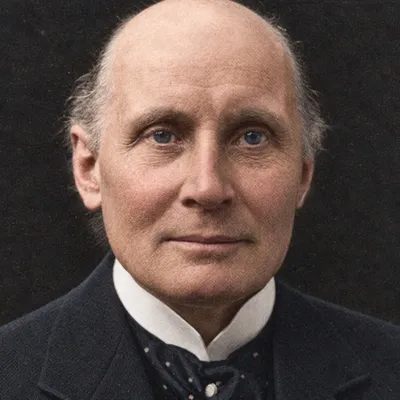
Foreign thinker
Alfred North Whitehead
Alfred North WhiteheadMetaphysics, Process Philosophy, and Mathematical LogicBritish1861–1947
The safest general characterization of the European philosophical tradition is that it consists of a series of footnotes to Plato.
In their times
Open in the Timeline of ThoughtInfluenced3


Influenced by2


Students2


Critiqued2


Same school1

Life and Thought
Alfred North Whitehead (1861–1947) was a British mathematician, logician, and philosopher, and co-author of Principia Mathematica with Bertrand Russell. In the second half of his life he turned to metaphysics, and with Process and Reality founded "process philosophy" — a system in which reality is composed not of fixed substances but of events and continuous becoming.
Alfred North Whitehead was born on 15 February 1861 in Ramsgate, Kent, England. He studied mathematics at Trinity College, Cambridge, and went on to teach there for many years. One of his students at Cambridge was Bertrand Russell; the collaboration between teacher and student produced the three-volume Principia Mathematica (1910–1913), a work that sought to show mathematics could be grounded in logic and that stands as one of the cornerstones of modern logic and analytic philosophy.
After Cambridge, Whitehead moved to London in 1910, teaching applied mathematics and mechanics at University College and then Imperial College. During this period his attention shifted from pure logic to the philosophy of science and the philosophy of nature. Works such as The Concept of Nature (1920) and An Enquiry Concerning the Principles of Natural Knowledge (1919) date from this phase; in them Whitehead sought to present a picture of nature in which the "event," not "matter," is the fundamental unit, and criticized what he called the "bifurcation of nature" — the separation of the world of perceived qualities from the world of scientific particles.
In 1924, at the age of sixty-three, Whitehead accepted an invitation from Harvard University to teach philosophy and emigrated to the United States, beginning the most fertile philosophical phase of his life. Science and the Modern World (1925) examined the metaphysical presuppositions of modern science, particularly scientific materialism. His masterwork, Process and Reality (1929), drawn from his Gifford Lectures at the University of Edinburgh, presented his complete cosmological system: the world is not a collection of fixed substances but a fabric of interwoven "actual occasions," each coming into being through the "prehension" of its past and of pure possibilities ("eternal objects"). In this system, God too is not an exception to metaphysical principles but their chief exemplification — a conception that later gave rise to process theology in America.
In Adventures of Ideas (1933), Whitehead turned to the history of civilization and the role of ideas in transforming it. He also criticized education built on the accumulation of "inert ideas" in The Aims of Education (1929). Whitehead died on 30 December 1947 in Cambridge, Massachusetts.