Foreign thinker
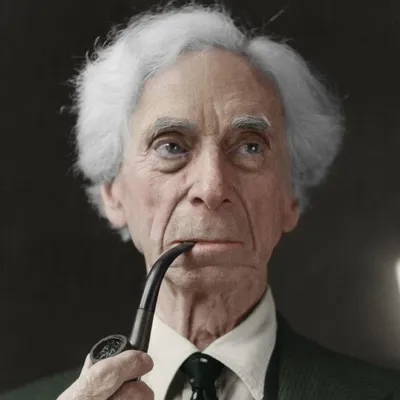
Bertrand Russell
Bertrand RussellPhilosophyBritish1872–1970
The most fundamental problem of our age is that people are surrounded by beliefs to which they cling with terrifying passion, while sufficient evidence for them is lacking.
In their times
Open in the Timeline of ThoughtInfluenced7


Influenced by5


Teachers2


Critiqued2


Critics2


Contemporaries2


Life and Thought
Bertrand Russell (1872–1970) was a British philosopher, logician, and mathematician, and one of the founders of analytic philosophy. In 1950, he received the Nobel Prize in Literature for his defense of freedom of thought and humanitarianism.
Bertrand Russell, born 18 May 1872 and died 2 February 1970, was a British philosopher, logician, mathematician, writer, and thinker. He is one of the leading figures of twentieth-century philosophy and among the founders of analytic philosophy. In 1950, Russell received the Nobel Prize in Literature for his literary and intellectual works in defense of freedom of thought and humanitarianism.
Russell was born into an aristocratic and cultured family in Britain and from his youth was drawn to mathematics, logic, and philosophy. Together with Alfred North Whitehead, in the landmark book Principia Mathematica, he sought to provide a logical foundation for mathematics—an endeavor that secured his place in the history of logic and the philosophy of mathematics.
Russell’s significance is not confined to specialist philosophy. He was a prolific writer who also addressed ethics, education, science, religion, the history of philosophy, happiness, society, and human life for a general audience. His clear prose, rigorous reasoning, and ability to simplify complex issues meant his works found a wide readership beyond the academy.
Russell had a profound influence on the philosophy of language, epistemology, logic, metaphysics, and the history of ideas. Works such as The Problems of Philosophy, “On Denoting,” A History of Western Philosophy, and The Analysis of Mind remain important resources for engaging with modern philosophy and analytic philosophy.
Bibliography
Writings and transcribed lectures25 titles
Problems of Philosophy
History of Western Philosophy
An Introduction to the Philosophy of Mathematics
Analysis of Mind
Our Knowledge of the External World
Philosophical Essays
Mysticism and Logic
Logical Atomism
An Inquiry into Meaningfulness and Truth
A Critical Exposition of the Philosophy of Leibniz
Scientific Worldview
Science and Religion
The Impact of Science on Society
The Conquest of Happiness
In Praise of Leisure / In Praise of Idleness
Marriage and Morals
On Education, Especially in Early Childhood
Education and the Better Life
Power
The Source of Authority and the Individual
The Autobiography of Bertrand Russell
My Philosophical Evolution
The Basic Writings of Bertrand Russell
The Alphabet of Relativity
The ABCs of a Good Citizen and the History of the World in a Word