Foreign thinker
Noam Chomsky
Noam ChomskyLinguistics, Philosophy, Political ThoughtAmericanb. 1928
In their times
Open in the Timeline of Thought


Life and Thought
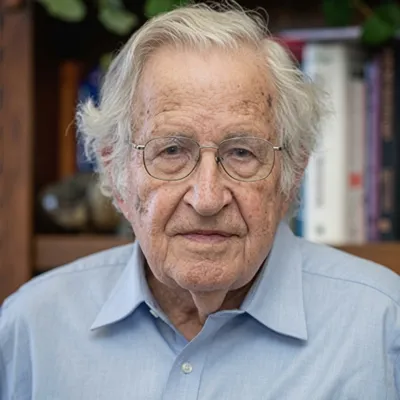
Noam Chomsky (born 1928) is an American linguist, philosopher of language, and cognitive science theorist. He is called the father of modern linguistics and, in addition to his scientific works, is considered one of the prominent critics of U.S. foreign policy and corporate capitalism.
Noam Chomsky (born December 7, 1928) is an American linguist, philosopher of language, cognitive science theorist, social critic, and one of the most renowned public intellectuals of the contemporary era. He is sometimes called "the father of modern linguistics" for having transformed the study of language. Chomsky is a professor emeritus at the Massachusetts Institute of Technology and joined the University of Arizona in 2017; according to the University of Arizona's official page, he is currently on leave.
Chomsky was born in Philadelphia into a cultured Jewish family. His father was a linguist and Hebrew scholar, and this environment shaped Chomsky's early interest in language, politics, and radical intellectual traditions. He studied at the University of Pennsylvania and, under the influence of the prominent linguist Zellig Harris, turned to the study of language structure. His doctoral dissertation laid the groundwork for the theory that later became known as generative grammar.
Chomsky joined the Massachusetts Institute of Technology in 1955 and spent a large part of his academic career there. The book Syntactic Structures, published in 1957, is one of the most important works of the twentieth century in linguistics. In it, he showed that language cannot be viewed merely as a set of habits or learned responses; rather, the human mind possesses a generative structure capable of producing an infinite number of new sentences. MIT's official page identifies his research areas as linguistic theory, syntax, semantics, and the philosophy of language.
Chomsky's famous critique of linguistic behaviorism, particularly his review of B. F. Skinner's theory, played a significant role in the decline of behaviorism and the strengthening of the cognitive revolution. By proposing the idea of Universal Grammar, he argued that the human capacity for language acquisition rests on innate, biological mental structures. His theories evolved over time, moving from transformational grammar and Government and Binding theory to the Minimalist Program.
Chomsky is also an important figure in the philosophy of language and mind. He viewed language as a window into the structure of the human mind and, contrary to purely behavioral or social approaches, emphasized the internal, biological, and cognitive aspects of language. In this respect, his works have been influential not only in linguistics but also in cognitive psychology, computer science, the philosophy of mind, and artificial intelligence.
Alongside his scientific work, Chomsky has been, since the 1960s, one of the foremost critics of U.S. foreign policy, the Vietnam War, military interventionism, neoliberalism, media concentration, and corporate capitalism. His 1967 essay "The Responsibility of Intellectuals" established him as a public intellectual on a national scale. From then on, his political activism and critical writings became an inseparable part of his intellectual profile.
One of his important political works is Manufacturing Consent, co-authored with Edward Herman. In this book, Chomsky and Herman proposed the "propaganda model," a model for explaining how mainstream media in capitalist societies reproduce specific frameworks of news and reality through ownership, advertising, news sources, and political and ideological pressures.
Chomsky is one of the most prolific contemporary authors, having published over a hundred books in the fields of linguistics, philosophy, politics, media, and social criticism. In terms of academic citations, he is considered one of the most influential figures in the humanities and social sciences. In recent years, especially after a stroke and a period of treatment in Brazil, his public presence has diminished; nevertheless, his standing in linguistics and contemporary political thought remains prominent.