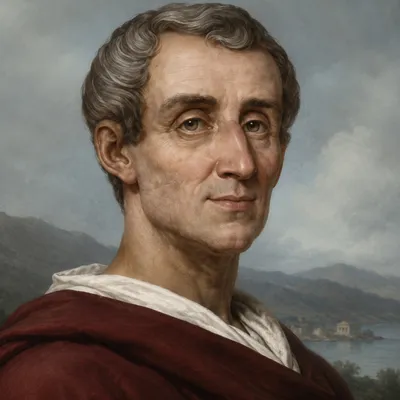
Foreign thinker
Montesquieu
MontesquieuPolitical philosophy and theory of governmentFrench1689–1755
“For power not to be abused, power must be arranged so that power checks power.”
In their times
Open in the Timeline of Thought


Life and Thought
Montesquieu was a French political philosopher, writer, and Enlightenment thinker whose theory of the separation of powers had a fundamental influence on modern political thought and the formation of constitutional systems. His most important work, The Spirit of the Laws, examined different forms of government, laws, and the relationship between political institutions and social conditions.
Montesquieu, whose full name was Charles-Louis de Secondat, Baron de La Brède et de Montesquieu, was a French political philosopher and writer of the Enlightenment. He was born on 18 January 1689 near Bordeaux, France, into an aristocratic family. After studying law, he worked in the judiciary and served for a time as a member of the Parliament of Bordeaux, but gained his greatest fame through his philosophical and political writings.
His first major work was Persian Letters, published in 1721. Using the form of fictional correspondence, the book criticized French society, political institutions, and customs of his time, establishing Montesquieu’s reputation among the critical writers of the Enlightenment.
Montesquieu’s most important work, The Spirit of the Laws, was published in 1748. In this book, he conducted a comparative study of governments and laws and developed his famous theory of the separation of powers among the legislative, executive, and judicial branches. For him, the division of power and the balance among governmental institutions were ways to prevent despotism and preserve political liberty.
Montesquieu’s ideas had a broad influence on the development of liberal political theory, constitutional design in various countries, and the formation of systems based on limiting governmental power. He also emphasized the importance of historical, cultural, geographical, and social conditions in shaping the laws of societies.