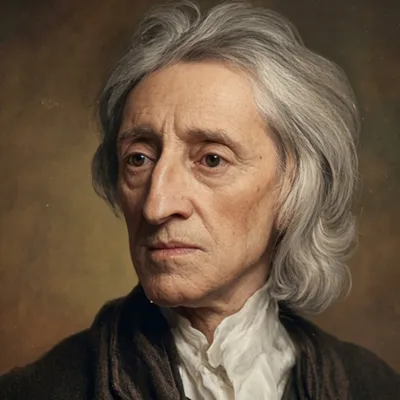
The human mind at birth is like a blank slate, with nothing written upon it; it is experience that fills it.
In their times
Open in the Timeline of Thought


Life and Thought
John Locke (1632–1704) was an English philosopher and a key figure of the Enlightenment. He is one of the founders of modern empiricism, and his ideas in political philosophy, epistemology, and education had a profound influence on later thinkers.
John Locke, born 29 August 1632 and died 28 October 1704, was an English philosopher and a major figure of the Enlightenment. He is considered one of the founders of modern empiricism and an influential thinker in political philosophy, epistemology, education, and the theory of liberty.
Locke was born in England and educated at Westminster School and then at Christ Church, Oxford. Alongside philosophy, he was also interested in medicine and the experimental sciences, and maintained intellectual and scientific connections with figures such as Robert Boyle, Robert Hooke, and Thomas Sydenham. This familiarity with the empirical method played a significant role in shaping his philosophy of knowledge.
In his book An Essay Concerning Human Understanding, Locke put forward the view that the human mind at birth is like a 'blank slate' and that knowledge is formed through experience and observation. This view had a wide-ranging impact on modern philosophy, psychology, education, and theories of cognition.
Locke also holds a central place in political philosophy. In Two Treatises of Government, he spoke of natural rights, property, the consent of the people, and the limited power of government. His ideas later influenced thinkers such as Voltaire, Rousseau, and many writers of the Enlightenment, and played an important role in shaping modern concepts of liberty, toleration, and the rule of law.
Bibliography
Writings and transcribed lectures9 titles
An Essay Concerning Human Understanding
A Treatise on Government
Two Treatises of Government
A Treatise on Tolerance
Questions about the Law of Nature
Thoughts on Education
The Rationality of Christianity
Some Thoughts on the Consequences of Lowering Interest Rates and Increasing the Value of Money
Letters on Toleration