Man is born free, and everywhere he is in chains.


Life and Thought
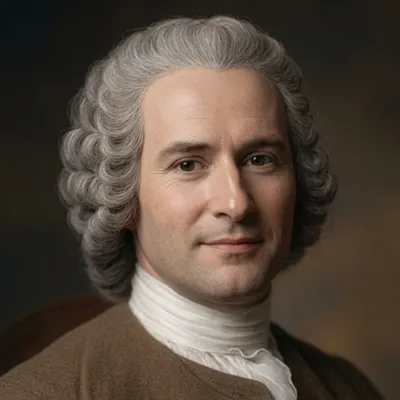
Jean-Jacques Rousseau (1712–1778) was a Genevan philosopher, writer, and composer whose works left a profound impact on political philosophy, literature, and education. Among his most important works are The Social Contract and Emile, or On Education.
Jean-Jacques Rousseau, born 28 June 1712 and died 2 July 1778, was a Genevan philosopher, writer, and composer. He was one of the major figures of the eighteenth century and among the thinkers whose works had a profound impact on political philosophy, literature, education, and modern culture.
Rousseau spent a significant part of his intellectual life in France and was engaged with the intellectual currents of the Enlightenment; yet in many of his writings, he took a critical view of civilization, apparent progress, social inequality, and the alienation of modern man. He believed that man is born free, but social structures can distance him from his natural and moral freedom.
His famous work The Social Contract is one of the foundational texts of modern political philosophy. In this book, Rousseau sought to explain the relationship between individual freedom, the general will, and collective life. His other book, Emile, or On Education, is an important work in the history of educational thought and emphasizes the importance of the child's natural development, direct experience, and the cultivation of an independent character.
Rousseau also holds a prominent place in literature. Julie, or the New Heloise, Confessions, and Reveries of the Solitary Walker are among the works that reveal the personal, emotional, and literary dimension of his thought. Rousseau's cultural significance lies in linking philosophy, literature, education, politics, and the inner experience of the human being—a link that influenced the French Revolution, Romanticism, and modern thought.
Bibliography
Writings and transcribed lectures16 titles
A Discussion on Modern Music
Treatise on Science and Art
The Village Soothsayer
Narcissus or the Lover of Himself
Discourse on the Origin of Inequality Among Men
Discourse on Political Economy
Letter to d'Alembert on the Theatre
Ethical Letters
The New Héloïse
The Social Contract
Emile, or On Education
Letters from the Mountains
Confessions
Dreams of a Solitary Walker
Thoughts in Solitude
Treatise on Faith and Belief


.webp)
.webp)