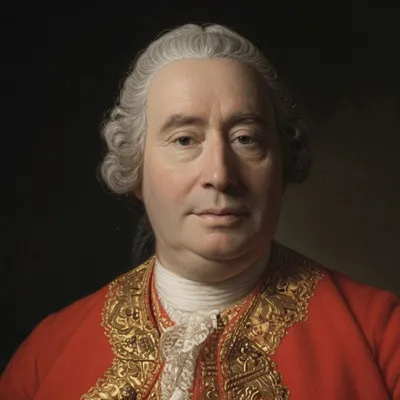
Foreign thinker
David Hume
David HumePhilosophyScottish1711–1776
Reason is, and ought only to be the slave of the passions, and can never pretend to any other office than to serve and obey them.


Life and Thought
David Hume was a Scottish philosopher, historian, and economist, and one of the prominent figures of the Scottish Enlightenment. He is one of the most important representatives of empiricism in Western philosophy, and his critique of causality had a profound impact on the philosophy of science.
David Hume, born 7 May 1711 and died 25 August 1776, was a Scottish philosopher, historian, economist, and essayist. He was one of the prominent figures of the Scottish Enlightenment and is considered one of the most important representatives of empiricism in Western philosophy.
Hume was born in Edinburgh and showed an early interest in philosophy, history, and literature. During his years in France, he wrote his most important philosophical work, "A Treatise of Human Nature"; a book in which he sought to examine the human mind, cognition, emotions, and morality through an empirical and naturalistic method.
Hume's thought was founded on the belief that a large part of human knowledge originates from experience. He raised fundamental discussions about causality, induction, personal identity, ethics, religion, and mental habit. His critique of causality and induction had a profound impact on the philosophy of science and epistemology, and Immanuel Kant later wrote that Hume had awakened him from his "dogmatic slumber."
In addition to philosophy, Hume was also an important figure in historiography, and his "History of England" was widely read in its time. His clear prose, skeptical outlook, precise analysis of human nature, and linking philosophy with everyday experience have made Hume one of the most enduring thinkers of the modern world.
Bibliography
Writings and transcribed lectures13 titles
A Treatise of Human Nature
Moral, Political, and Literary Essays
An Enquiry Concerning Human Understanding
An Inquiry into the Foundations of Ethics
Political Discourses
Four Treatises
The Natural History of Religion
History of England
My Life
Conversations on Natural Religion
On the Criterion of Taste
On Tragedy
On the Passions of the Soul