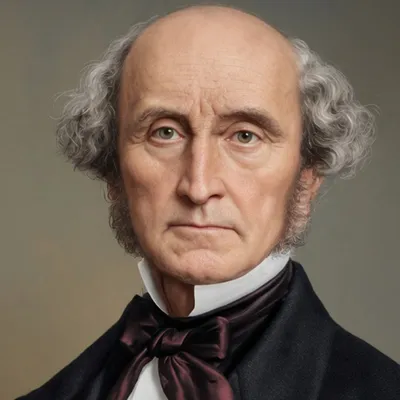
Foreign thinker
John Stuart Mill
John Stuart MillPhilosophyEnglish1806–1873
Over himself, over his own body and mind, the individual is sovereign.


Life and Thought
John Stuart Mill (1806–1873) was a British philosopher, economist, and political thinker. He is one of the leading figures of classical liberalism and utilitarianism, and his works have had a wide-ranging influence on moral philosophy, logic, and women's rights.
John Stuart Mill, born 20 May 1806 and died 8 May 1873, was a British philosopher, writer, economist, and political thinker. He is considered one of the most important figures of classical liberalism and utilitarianism in the nineteenth century, and his works have had a wide-ranging influence on moral philosophy, logic, political economy, individual liberty, and women's rights.
Mill was subjected to a rigorous education by his father, James Mill, from childhood and became acquainted with classical languages, philosophy, logic, and economics at a very early age. In his youth, he encountered the ideas of Jeremy Bentham, the utilitarian tradition, and French intellectual currents, and later sought to reinterpret utilitarianism with attention to the quality of human experience, individual liberty, and personal development.
Mill's cultural and intellectual fame rests above all on the book "On Liberty"; a work in which he defends freedom of thought, expression, and individual lifestyle, and examines the limits of society's and government's interference in individuals' lives. In "The Subjection of Women," he also advocated for the legal and social equality of women and is considered one of the intellectual pioneers of women's rights in the modern world.
In addition to his theoretical work, Mill was also active in politics and served for a time as a Member of Parliament in the British House of Commons. His lucid prose, concern for social reform, and effort to link liberty, ethics, and the common good made him one of the most influential political and moral thinkers of the Victorian era.
Bibliography
Writings and transcribed lectures14 titles
The System of Logic
Principles of Political Economy / Foundations of Political Economy
On Freedom
Reflections on Elective Government
Utilitarianism
The Subjection of Women
Autobiography
Auguste Comte and Positivism
An Examination of Sir William Hamilton's Philosophy
Three Essays on Religion
Theory of Poetry
Notes on Socialism
Essays on Some Unsettled Questions of Political Economy
On the Path to Freedom