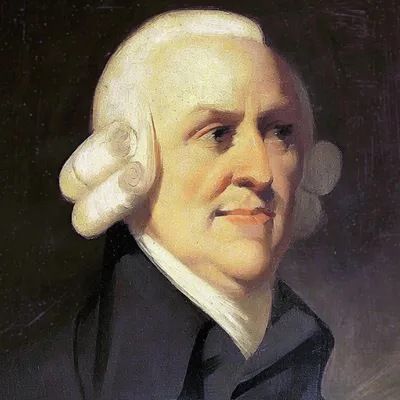
It is not from the benevolence of the butcher, the brewer, or the baker that we expect our dinner, but from their regard to their own self-interest.


Life and Thought
Adam Smith was a Scottish moral philosopher and thinker of the Enlightenment who played a significant role in shaping political economy and modern thought about society and wealth. He is the author of <i>The Theory of Moral Sentiments</i> and <i>An Inquiry into the Nature and Causes of the Wealth of Nations</i>.
Adam Smith, born 5 June 1723 and died 17 July 1790, was a Scottish moral philosopher and thinker of the Enlightenment. He is considered one of the most important intellectual figures of the eighteenth century and played a significant role in shaping political economy and modern thought about society, morality, labor, and wealth.
Smith was born in the town of Kirkcaldy, Scotland, and entered the University of Glasgow as a teenager. There he studied moral and social philosophy, and later continued his education at Balliol College, Oxford. After returning to Scotland, he taught logic and then moral philosophy at the University of Glasgow; an environment that was, at the time, one of the key centers of the Scottish Enlightenment.
Adam Smith established his position as a moral philosopher with the book <i>The Theory of Moral Sentiments</i>. In this work, he discusses sympathy, moral judgment, and the connection between the individual and society. His other famous work, <i>An Inquiry into the Nature and Causes of the Wealth of Nations</i>, is one of the first systematic attempts to understand labor, production, trade, the division of labor, and the economic mechanisms of modern societies.
Smith's cultural and intellectual significance lies in the fact that he understood economics through the lens of moral philosophy, history, and the study of human behavior. He was not merely a theorist of the market, but a thinker who sought to explain the relationship between morality, self-interest, social order, and public welfare. His works continue to be studied and debated in philosophy, economics, the social sciences, and the history of ideas.
Bibliography
Writings and transcribed lectures5 titles
Theory of Moral Sentiments
An Inquiry into the Nature and Causes of the Wealth of Nations
Articles on Philosophical Topics
Lectures on Rights and Law
Lectures on Rhetoric and Belles Lettres



.webp)