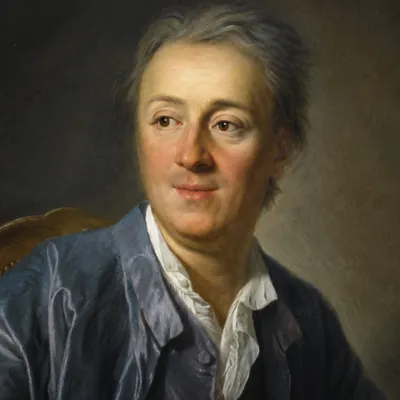
Foreign thinker
Denis Diderot
Denis DiderotPhilosophy of the Enlightenment and literary criticismFrench1713–1784
“Man will never be free until the last king is strangled with the entrails of the last priest.”


Life and Thought
Denis Diderot was a French philosopher, writer, and art critic, and one of the leading figures of the Enlightenment. As the chief editor of the Encyclopédie, he played an important role in expanding knowledge, promoting rationalism, and criticizing traditional authorities in eighteenth-century Europe.
Denis Diderot (1713–1784) was a French philosopher, writer, playwright, and art critic, and one of the most important thinkers of the Enlightenment movement. He was born on 5 October 1713 in Langres, France, into a bourgeois family. After studying the humanities and philosophy in Paris, he turned to writing and intellectual activity and became one of the leading figures of French intellectual circles.
Diderot’s most important achievement was his editorial contribution to the project of the Encyclopédie, or a Systematic Dictionary of the Sciences, Arts, and Crafts, which he began with Jean le Rond d’Alembert. This monumental work, whose publication started in 1751, sought to collect and organize the knowledge of its time and promote scientific, critical, and secular ideas.
In his philosophical and literary works, Diderot explored themes such as materialism, human nature, ethics, art, and freedom of thought. His important works include Letter on the Blind for the Use of Those Who Can See, Rameau’s Nephew, and Jacques the Fatalist and His Master. He also played an important role in art criticism, especially in the fields of painting and theatre.
Diderot’s thought was closely connected with the critical spirit of the Enlightenment. He defended the rational examination of the world, the expansion of education, and criticism of traditional institutions, and his works had a significant influence on the development of modern European philosophy, literature, and culture.