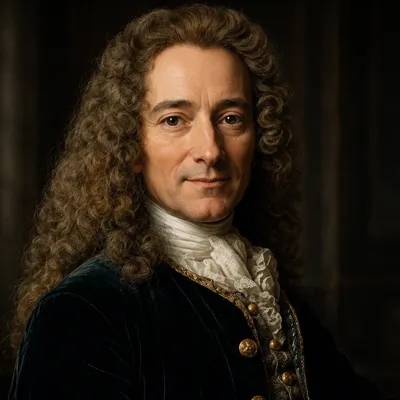
Foreign thinker
Voltaire
VoltaireEnlightenment philosophy, religious criticism, writing and literatureFrench1694–1778
"I disapprove of what you say, but I will defend to the death your right to say it."
In their times
Open in the Timeline of Thought


Life and Thought
Voltaire, whose real name was François-Marie Arouet, was a French philosopher, writer, and thinker of the Enlightenment. He was known for defending freedom of thought, religious tolerance, criticizing despotism, and playing an important role in shaping the intellectual climate before the French Revolution.
Voltaire, born François-Marie Arouet, was born in Paris in 1694. He began his education in French literary and legal circles and became known from a young age for his critical and satirical writings. His intellectual activities repeatedly brought him into conflict with authorities and official institutions, leading to imprisonment in the Bastille and periods of exile.
Voltaire was one of the leading figures of the European Enlightenment. He defended reason, experience, freedom of expression, and religious tolerance while opposing fanaticism, superstition, and political despotism. Although he was not a systematic philosopher in the traditional sense, his writings had a broad influence on political philosophy, public culture, and modern social thought.
Among his major works are Candide, Lettres philosophiques, and Traité sur la tolérance. In Candide, he used satire to criticize excessive philosophical optimism, while in Treatise on Tolerance he emphasized peaceful coexistence among followers of different religions.
Voltaire spent the final years of his life near Geneva and later in France, dying in Paris in 1778. His intellectual legacy remains associated with freedom of expression, secularism, tolerance, and criticism of power.