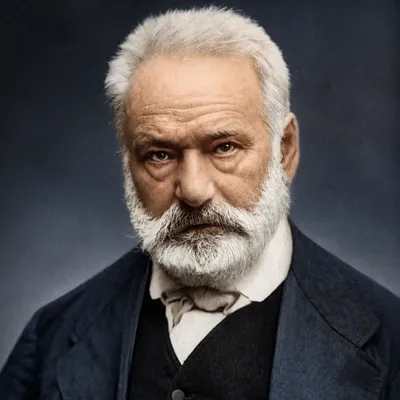
Foreign thinker
Victor Hugo
Victor HugoLiterature, novel writing, and poetryFrench1802–1885
"Nothing is more powerful than an idea whose time has come."


Life and Thought
Victor Hugo was a French poet, novelist, and playwright and one of the most prominent figures of nineteenth-century French literature. Through works such as "Les Misérables" and "The Hunchback of Notre-Dame," as well as his poems and political writings, he played an important role in French Romanticism and social thought.
Victor Hugo was born on February 26, 1802, in Besançon, France. From a young age, he was interested in literature and became one of the major figures of French Romanticism through his poetry and literary works. His early poetry collection, "Odes and Miscellaneous Poems" (1826), established his reputation in literary circles.
Throughout his life, Hugo worked in various literary forms, producing important works in poetry, novels, drama, and essays. His novel "The Hunchback of Notre-Dame" (1831) gained wide recognition for its historical and human portrayal of medieval Paris. His masterpiece, "Les Misérables" (1862), focused on poverty, social justice, redemption, and the condition of the marginalized, becoming one of the most enduring novels in world literature.
Hugo's social and political thought was closely connected with his defense of freedom, justice, and human rights. He opposed the government of Napoleon III and spent years in exile. His writings, especially in his later years, reflected his ethical, human, and social concerns about society and the fate of humanity.
Victor Hugo died on May 22, 1885, in Paris. He is recognized as one of the greatest writers in French literary history, and his works continue to be read and adapted throughout the world.