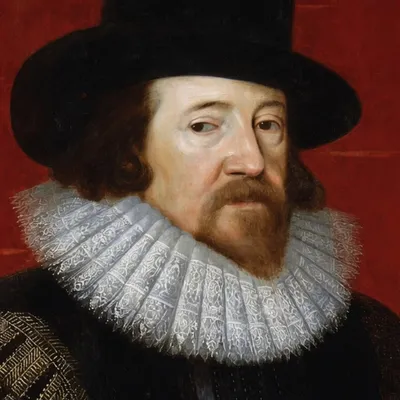
Foreign thinker
Francis Bacon
Francis BaconPhilosophyEnglish1561–1626
Knowledge is power.


Life and Thought
Francis Bacon (1561–1626) was an English philosopher who played a prominent role in shaping the empirical method and a new outlook on science. Emphasizing observation and experience, he outlined a program for the renewal of knowledge and wrote works such as Novum Organum and the Essays.
Francis Bacon, born 22 January 1561 and died 9 April 1626, was an English philosopher, writer, jurist, and statesman. He is one of the key figures of the early modern period and among the thinkers who played a prominent role in shaping the empirical method and a new outlook on science.
Bacon was born in London into a family connected to the English government. As a teenager he attended Trinity College, Cambridge, where he became acquainted with the formal education of his time, but he later distanced himself from many traditional modes of learning and emphasized observation, experience, and the systematic collection of data.
Bacon's intellectual significance lies in his proposal of a program for the "renewal of knowledge." He believed that science should move beyond abstract debates and the repetition of traditions, and through careful observation of nature, experience, and the inductive method, be put to use for the benefit of human life. The Stanford Encyclopedia of Philosophy also identifies his works, especially The Advancement of Learning and Novum Organum, as central to his program for reforming and expanding knowledge.
In addition to the philosophy of science, Bacon holds an important place in English prose. His Essays are outstanding examples of concise, aphoristic, and reflective prose in English literature. The book New Atlantis also presents a utopian vision of a knowledge-based society and is considered one of the important texts in the history of scientific and philosophical imagination.
Bibliography
Writings and transcribed lectures15 titles
Essays
The Advancement of Knowledge
The Wisdom of the Ancients
New Atlantis
The Great Revival / The Great Renewal of Knowledge
Novum Organum
The History of the Seventh Art
A History of Winds
The History of Life and Death
On Dignity and the Progress of Knowledge
Silva Silvarum, or A Forest of Forests
Political and Social Studies
Sacred Meditations
Discourses on Law and Justice
Letters, Speeches, and Political and Administrative Writings