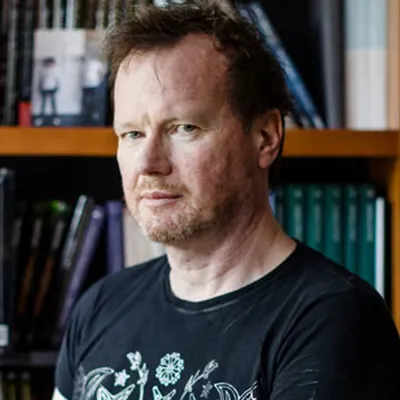
Foreign thinker
Timothy Morton
Timothy MortonEnvironmental philosophy, object-oriented theory, ecological philosophyEnglishb. 1968
“Dark ecology puts us in a weird situation where we are forced to coexist with beings we cannot fully know.”


Life and Thought
Timothy Morton is an English philosopher and literary theorist known for his works in environmental philosophy, dark ecology, and object-oriented theory. By criticizing the human–nature dualism, he emphasizes the entanglement of living beings and nonhuman entities and is considered an influential figure in contemporary environmental philosophy.
Timothy Morton was born in 1968 in England. He continued his studies in English literature and later became one of the influential figures connecting philosophy, literary studies, social theory, and environmental thought. Morton is a professor at Rice University in the United States, and his research focuses on the relationship between humans and the nonhuman world.
Morton is known for the concept of “dark ecology,” an approach that emphasizes the complexity, ambiguity, and sometimes unsettling nature of humanity’s encounter with environmental crises. He argues that ecological crises are connected to the traditional view of humans as separate from and dominant over nature, and that a new understanding of the relationship between humans, other beings, and objects is required.
His important works include Ecology Without Nature (2007), The Ecological Thought (2010), and Humankind: Solidarity with Non-Human People (2017). Morton is also closely associated with Object-Oriented Ontology and argues that objects and nonhuman beings possess realities independent of their use or human perception.
Morton’s ideas have influenced environmental philosophy, literary studies, environmental ethics, and contemporary theory. He seeks to provide new philosophical concepts and language for understanding the age of ecological crisis and the complex relationship between humans and the Earth.