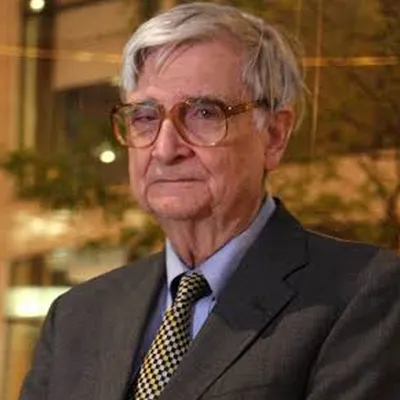
Foreign thinker
Edward O. Wilson
Edward O. WilsonEvolutionary biology, sociobiology, and ecologyAmerican1929–2021
"To make room for nature is to make room for our own future."


Life and Thought
Edward O. Wilson was an American biologist and one of the most influential researchers in evolutionary biology, ecology, and animal behavior. He developed and expanded the theory of sociobiology and, through his extensive studies of ants, had a profound impact on understanding the relationship between evolution, social behavior, and nature.
Edward O. Wilson was born in 1929 in Birmingham, Alabama, USA. From an early age, he developed an interest in nature and insects, and a significant part of his scientific career was devoted to the study of ants and insect societies. He studied at the University of Alabama and later at Harvard University, where he spent many years as a professor.
Wilson was one of the founders of sociobiology, a field that examines animal social behavior through the principles of evolutionary biology. His book "Sociobiology: The New Synthesis" (1975) was one of his most important works, proposing explanations for how natural selection can influence the development of social behaviors.
He also worked extensively on biodiversity and environmental conservation. His book "The Diversity of Life" (1992) and later writings on species extinction emphasized the importance of protecting ecosystems for humanity's future. Wilson also proposed the idea of "Half-Earth," advocating the protection of a large portion of the planet for the preservation of nature.
Wilson's works stand at the intersection of biology, philosophy of science, environmental ethics, and studies of humanity. He died in 2021 and is regarded as one of the most influential biologists of the twentieth century and a major advocate for biodiversity conservation.