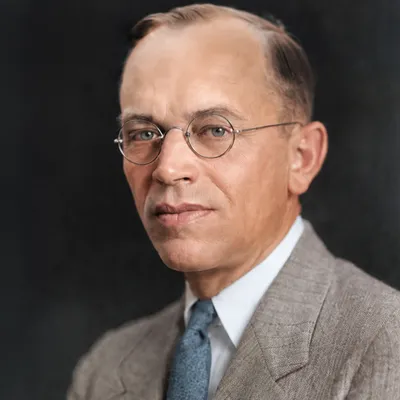
Foreign thinker
Aldo Leopold
Aldo LeopoldEnvironmental philosophy, ecology, and nature conservationAmerican1887–1948
"The land ethic expands the boundaries of the community to include soils, waters, plants, and animals."
In their times
Open in the Timeline of Thought


Life and Thought
Aldo Leopold was an American ecologist, forester, and environmental thinker who is considered one of the founders of modern conservation thought and the land ethic. In his book "A Sand County Almanac," he introduced the idea of an ethical relationship between humans and the biotic community and left a lasting influence on environmental philosophy and conservation movements.
Aldo Leopold was born in 1887 in Burlington, Iowa, United States. He studied forestry at Yale University and later joined the United States Forest Service. During his professional career, he played an important role in natural resource management, wildlife conservation, and environmental policy, becoming one of the influential figures in the formation of the modern conservation movement in America.
Leopold gradually changed his view of the relationship between humans and nature. He argued that humans should not see themselves as owners of nature, but as members of a broader biotic community. His key idea, the "Land Ethic," expanded ethics from human relationships to the relationship between humans, soil, water, plants, and animals.
His most important work, "A Sand County Almanac," published after his death in 1949, became a classic of environmental literature. In this book, Leopold wrote philosophically and poetically about the intrinsic value of nature, human moral responsibility, and the importance of preserving biodiversity.
Leopold's ideas have had a major influence on environmental philosophy, ecology, wildlife conservation, and contemporary environmental movements. He died in 1948 while attempting to extinguish a fire on a neighbor's land, after suffering a heart attack.