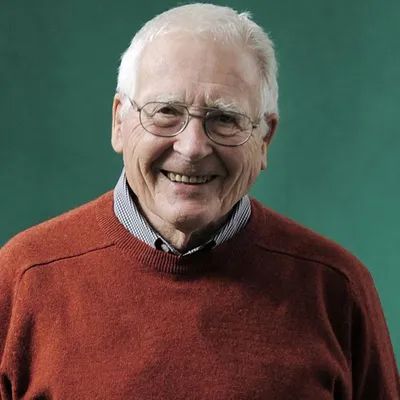
Foreign thinker
James Lovelock
James LovelockEarth sciences, ecology, Gaia theoryBritish1919–2022
"Gaia is not a living being; rather, it is a self-regulating system composed of all living beings and their physical environment."


Life and Thought
James Lovelock was a British scientist in the fields of Earth sciences, atmospheric chemistry, and ecology, best known for proposing the Gaia theory, which views Earth as a self-regulating system. Through his research on the relationship between living organisms and planetary processes, he had a significant influence on environmental thought and climate science.
James Lovelock was born in 1919 in Letchworth Garden City, England. He studied at the University of Manchester and later conducted research in chemistry, medicine, and biological sciences. A major part of his scientific work focused on Earth's atmosphere, environmental pollution, and the relationship between biological processes and planetary changes.
In the 1960s, while working with scientific and space organizations, Lovelock studied the possibility of detecting life on other planets and developed the idea that later became known as the Gaia theory. According to this theory, Earth can be understood as a complex system in which living organisms and non-living factors interact to maintain conditions suitable for the continuation of life. This view had a major impact on ecology, Earth sciences, and environmental philosophy, although some aspects of it have remained scientifically debated.
Among his important works are Gaia: A New Look at Life on Earth (1979) and The Ages of Gaia (1988). In his writings, Lovelock warned about environmental crises, climate change, and the need to reconsider humanity’s relationship with nature. He remained a prominent figure in discussions about climate change and the future of the planet until his death in 2022.