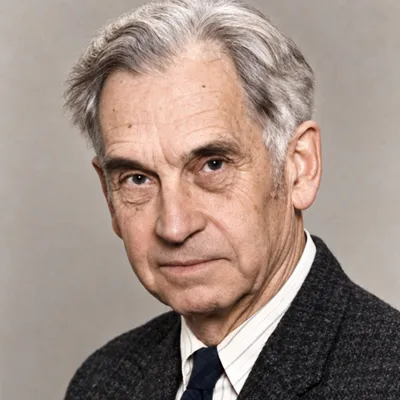
Foreign thinker
Ernst Mayr
Ernst MayrEvolutionary biologyGerman-American1904–2005


Life and Thought
Ernst Mayr was a German-American evolutionary biologist and one of the principal architects of the twentieth-century modern synthesis, which united Darwinian natural selection with population genetics. Through his biological species concept and his theory of geographic speciation, he left a lasting mark on both evolutionary biology and the philosophy of biology. Mayr spent most of his career at Harvard University's Museum of Comparative Zoology.
Ernst Walter Mayr was born on July 5, 1904, in Kempten, Germany. Drawn to ornithology from a young age, he completed his doctorate at the University of Berlin and, in the 1920s, undertook field expeditions to New Guinea and the Solomon Islands to study regional bird species — fieldwork that later grounded much of his thinking on geographic speciation. He emigrated to the United States in 1931, joining the American Museum of Natural History in New York, and from 1953 onward worked at Harvard's Museum of Comparative Zoology for the rest of his career.
Mayr was a central figure in the modern synthesis, the mid-twentieth-century movement that fused Darwin's theory of natural selection with Mendelian genetics and population biology. His book Systematics and the Origin of Species (1942) is regarded as a foundational text of that movement, in which he elaborated the concept of allopatric speciation — geographic isolation of populations as the principal driver of new species formation.
Among his other major contributions was his defense of the biological species concept, which defines a species not by physical resemblance but by the capacity of populations to interbreed and produce fertile offspring — a definition that remains widely used in evolutionary biology today. Mayr was also active in the philosophy of biology; in later works such as The Growth of Biological Thought (1982), he offered a historical and philosophical reexamination of foundational biological concepts, including the distinction between proximate and ultimate causation.
Over the decades, Mayr engaged in scientific debate with numerous biologists and philosophers of science, notably challenging philosopher Karl Popper's claim that natural selection was untestable, and later opposing strongly gene-centric approaches in evolutionary biology. He remained intellectually active until the end of his life, dying on February 3, 2005, at the age of 100, in Bedford, Massachusetts.