Philosophy
Lectures on “Kant: A Guide to Reading the Critique of Pure Reason”
Kant's Critique of Pure Reason defined the agenda of modern philosophy, and no one can philosophize without engaging with him. Vaez's lectures teach the book's topics as a guide to understanding the text, especially for non-students.
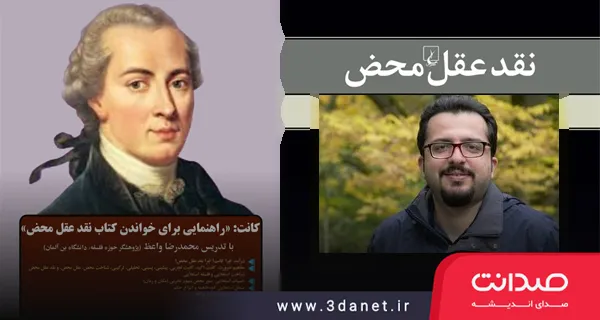
Lectures on “Kant: A Guide to Reading the Critique of Pure Reason”
Mohammad Reza Vaez Shahrestani
Philosophy researcher (mrvaez@uni-bonn.de)
Philosophy and the history of philosophy are one. We cannot engage with one independently of the other. Therefore, if one wishes to have an adequate understanding of specific problems, questions, and subjects in the field of philosophy, it is essential to know their background. In this context, Kant is the most important philosopher of the modern era, and the book Critique of Pure Reason (1787) is one of the most important philosophical books in the history of philosophy to this day.[1]
Kant is a foundational figure in the Western tradition over the past several centuries. He, especially in the Critique of Pure Reason, synthesized the views of his predecessors in the early modern period (rationalists and empiricists) and defined much of the agenda for posterity in the nineteenth, twentieth, and twenty-first centuries (idealist, pragmatist, neo-Kantian, analytic, and continental). To this day, epistemologists, philosophers of language, and metaphysicians have been occupied with issues that have been indelibly formulated by Kant. Moreover, even when Kant himself did not formulate them, his conceptual resources are equally sufficient for illuminating them. In this regard, the phrase is attributed to Otto Liebmann[2]: "Anyone can philosophize for or against Kant, but no one can philosophize without taking Kant into account."[3] Hence, the necessity of providing a guide for those interested in philosophy to read this book, especially for individuals who cannot access such an opportunity through university and academic courses, seems essential.
These sessions are dedicated to teaching some of the important topics of the book Critique of Pure Reason, as an introductory guide, for a better understanding of the text of this book while studying. It should be noted that the first series of the present lectures, with modifications, was held over six sessions for master's students in the Philosophy of Science at the University of Isfahan as part of the Western Philosophy course in the second semester of 1397, and also in eight sessions, in the summer and autumn of 1398 at the House of Wisdom in Isfahan.
The most important topics discussed in these lectures:
1) Introduction: Why Kant? Why the Critique of Pure Reason?;
2) The concepts of necessity, strict universality, empirical universality, a priori, a posteriori, analytic, synthetic, pure cognition, pure reason and the critique of pure reason, transcendental cognition, and transcendental philosophy;
3) Transcendental Aesthetic: The pure forms of empirical intuition (space and time);
4) Transcendental Logic: The faculty of understanding and the types of judgment;
5) The twelve categories and the schema;
6) Causality, Hume, and Kant;
7) The faculty of imagination and the metaphysics of experience;
8) The faculty of reason;
.
.
[1] Taylor, C. 1984. ‘Philosophy and its History’, in R. Rorty et al. (eds.), Philosophy in History. Cambridge: Cambridge University Press, 17–30.
[2] Otto Liebmann
[3] Quoted from:
Goldberg, N. J. 2015. Kantian Conceptual Geography. Oxford University Press. pp. 1-3.
.
.
Lectures on “Kant: A Guide to Reading the Critique of Pure Reason”
Khaneye Hekmat, 2019
English text of the Critique of Pure Reason, translated by Paul Guyer
.
.
.
.
Slides for Sessions One, Two, and Three
.
.
.
Slides for Sessions Four and Five
.
.
.
.
Slides for Sessions Six, Seven, and Eight
.
.



Discussion1 comments
سلام و ارادت درس گفتارهاي استاد واعظ شهرستاني فوقالعاده است . اَيكاش چهار جلسه باقي مانده اگر برگزار شده بار گذاري فرماييد. ممنون و سپاس از تلاش هاي پر ثمر گروه صدانت??????????