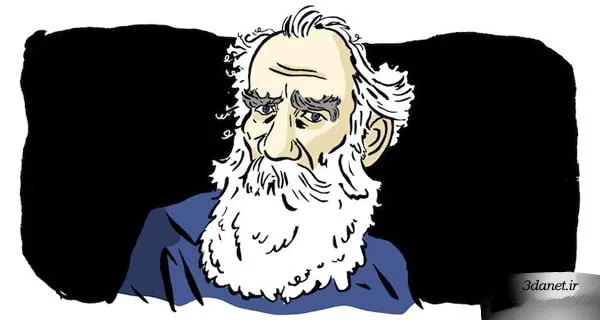
All happy families are alike; each unhappy family is unhappy in its own way.


Life and Thought
Leo Nikolayevich Tolstoy (1828–1910) was a Russian writer, moral thinker, and social critic who, with works such as War and Peace and Anna Karenina, attained an unparalleled place in world literature. He was drawn to simple living and nonviolence and influenced peace movements.
Leo Nikolayevich Tolstoy (September 9, 1828 – November 20, 1910) was a writer, moral thinker, social critic, and one of the greatest novelists in the history of world literature. With works such as War and Peace and Anna Karenina, he attained an unparalleled place in Russian and world literature; works that depict individual life, history, ethics, family, war, faith, and the meaning of existence with a rare breadth.
Tolstoy was born at Yasnaya Polyana, into an aristocratic and ancient family. He lost his mother in childhood and his father a few years later, becoming acquainted with the experience of loss and loneliness from the very beginning of his life. He studied Oriental languages and then law at Kazan University, but left his university education unfinished and returned to the family estate. The concern for the lives of peasants and the reform of their condition took shape in his mind from those years.
In his youth, Tolstoy joined the army and served in the Caucasus and then in the Crimean War. The experience of war became one of the main sources of his fictional world. In the Sevastopol Sketches, he showed war not as an official epic, but in its real and human face: fear, death, courage, futility, and suffering. This anti-heroic perspective later reached its peak in War and Peace.
After leaving the army, Tolstoy traveled in Europe and became acquainted with Western ideas and educational systems. He founded a school for peasant children at Yasnaya Polyana and showed an interest in free and non-coercive education. From that time on, Tolstoy did not consider writing merely a literary task; for him, writing was a way to test the truth of life and morality.
War and Peace, written in the 1860s, is Tolstoy's most expansive work and one of the masterpieces of world novel-writing. Set against the backdrop of the Napoleonic Wars, this novel interweaves the lives of Russian aristocratic families with questions about history, free will, love, death, and the meaning of life. Anna Karenina is also a profound portrait of love, family, society, and the inner collapse of a human being, and is considered psychologically one of the most precise novels of the nineteenth century.
In the middle years of his life, Tolstoy experienced a deep inner and spiritual crisis. After literary fame and social success, he turned to questioning the meaning of life, death, faith, and morality. This crisis was reflected in works such as A Confession. From this time onward, Tolstoy increasingly gravitated toward simple living, the rejection of violence, criticism of property, criticism of the state, opposition to war, and a return to an unmediated Christian ethics.
Tolstoy's moral and religious ideas had a wide influence on pacifist and reformist movements. His view of nonviolence later influenced figures such as Mahatma Gandhi. In the final years of his life, Tolstoy was caught between worldwide fame, a tense family life, the ideal of poverty, and a desire for inner liberation. He finally left home and fell ill at Astapovo railway station, dying on November 20, 1910.