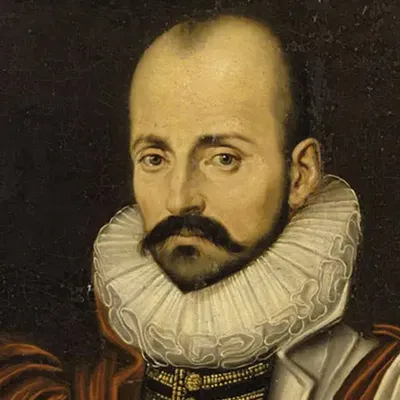
Foreign thinker
Michel de Montaigne
Michel de MontaignePhilosophy, essay writingFrench1533–1592
What do I know?


Life and Thought
Michel de Montaigne was a prominent philosopher and writer of the French Renaissance and one of the founders of modern essay writing. His celebrated work, Essays, combines self-examination, skepticism, observation of the human psyche, and reflection on how one ought to live.
Michel de Montaigne, the French philosopher, writer, and statesman, was born in 1533 and died in 1592. Raised in an affluent family, he received a humanist education centered on Latin from early childhood. After studying law, Montaigne worked for a time in the judiciary and politics and later served two terms as mayor of Bordeaux.
In 1571, he withdrew from most of his official duties and devoted much of his time to reading and writing in the library tower of his residence, although he never entirely abandoned public life. This period produced Essays, a work whose title helped name and establish the essay as a distinct form of literature and thought.
In Essays, Montaigne made himself the principal subject of inquiry, yet used personal experience to explore universal questions concerning death, friendship, education, the body, habit, religion, politics, the human psyche, and the limits of knowledge. His skepticism is embodied in the celebrated question, “What do I know?” Instead of constructing a philosophical system, he regarded philosophy as a practice of self-knowledge, tolerance, and living better. His thought and style influenced writers and thinkers such as René Descartes, Jean-Jacques Rousseau, Friedrich Nietzsche, and many later essayists.