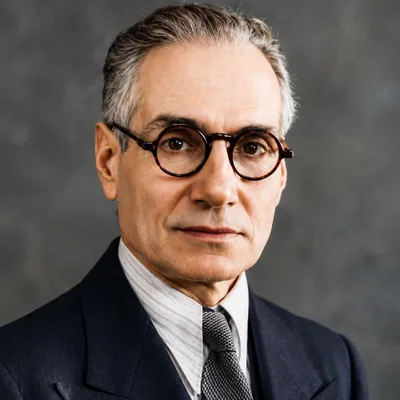
Iranian thinker
Ahmad Kasravi
Ahmad KasraviHistoriography, linguistics, law, and social thoughtIranian1890–1946
"One must think for oneself and avoid blind imitation and following."


Life and Thought
Ahmad Kasravi was an Iranian historian, linguist, jurist, and thinker who worked in the fields of history, language, literature, religious studies, and social reform. Through works such as "The History of the Constitutional Revolution of Iran" and "Azari or the Ancient Language of Azerbaijan," he made significant contributions to Iranian historical and linguistic studies and became one of the most controversial figures in modern Iranian intellectual history.
Ahmad Kasravi, whose original name was Seyyed Ahmad Hokmabadi Tabrizi, was born on 8 Mehr 1269 in Hokmabad, Tabriz. He grew up in a religious family, studied Islamic sciences at the Talebieh School in Tabriz during his youth, and for a period wore clerical clothing. After experiencing religious activities and becoming acquainted with the Constitutional movement, he gradually moved away from this path and turned toward the study of history, linguistics, and modern sciences.
Kasravi worked at different times as a teacher, judge, jurist, and professor of law at the University of Tehran. In his historical research, he examined Iran's political and social developments. His books "The History of the Constitutional Revolution of Iran" and "The Eighteen-Year History of Azerbaijan" are among his most important works on the Constitutional movement. In "Azari or the Ancient Language of Azerbaijan," he presented a theory about the Iranian character of the historical language of Azerbaijan before the spread of Azerbaijani Turkish.
In addition to historiography and linguistics, Kasravi criticized traditional beliefs and opposed what he considered superstition and intellectual stagnation. He introduced the movement of "Pakdini" with the aim of presenting a kind of secular and reformist Iranian identity. His views on religion, culture, classical Persian poetry, and social institutions provoked many reactions and oppositions.
Ahmad Kasravi was assassinated on 20 Esfand 1324 in the Palace of Justice in Tehran by members of the Fada'iyan-e Islam group. Despite extensive disagreements over his ideas, he remains one of the influential and controversial figures in Iranian intellectual history in the fourteenth century of the Solar Hijri calendar.