Philosophy
Bertrand Russell’s “The Ethics of War”
Bertrand Russell’s “The Ethics of War” is a philosophical reflection on the moral justification of war, the relationship between ethics and politics, and the human consequences of organized violence. In this essay, Russell examines different forms of war and seeks to offer criteria for making moral judgments about wars and the motivations behind them.
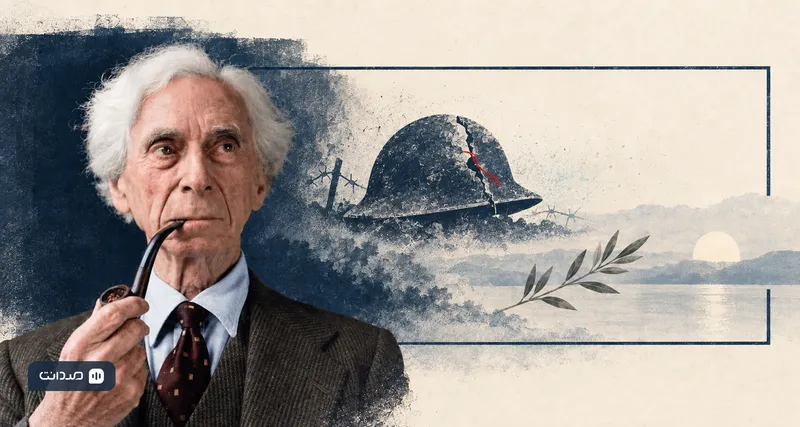

Bertrand Russell
Author
Arian Rasouli
Translator and Foreword AuthorTranslator’s Preface
Translating this essay was not merely a matter of choosing a text from among the works of a great contemporary philosopher. I do not even agree with many of Russell’s points in this essay, despite all the knowledge, awareness, and depth of insight for which he is known, and despite the fact that few in the modern era have matched his precision of thought and clarity of expression, even when he puts forward arguments that we may consider mistaken. When this translation was taking shape, war was no longer a distant subject confined to history books; war stood before us.
Today, on September 12, 2026, Iran finds itself in the midst of a war in which one side is Iran and the other side consists of the United States, the world’s military and economic superpower, and Israel, one of the region’s major military powers. This confrontation has moved beyond the level of a limited regional dispute, extending into vital waterways, energy markets, and the security of numerous countries in the region. Current reports also indicate the continuation of direct conflict between Iran and the United States, alongside simultaneous escalation in West Asia and crises in the Persian Gulf and the Red Sea.
We still do not know whether what we are witnessing should be regarded as the beginning of a Third World War, part of a broader regional war, or a phase of a passing crisis. But one reality cannot be ignored: Iran stands at the center of one of the most sensitive geopolitical confrontations of our time.
For Iran, this situation is not merely a matter of foreign policy or competition among states. The fate of a country, a society, and a land is at stake. It is a historical moment between existence and nonexistence, or at the very least, between facing grave dangers and avoiding them. In such circumstances, speaking about war cannot be merely a discussion of strategy, weapons, victory, and defeat.
We must ask again: What is war? When can it be considered justified? What duties does humanity have in the face of it?
It was precisely in such circumstances that returning to a short essay by Bertrand Russell acquired a different meaning for me. Not because I found all of his answers entirely convincing, but because a profound and careful philosopher had raised questions deeply aligned with our concerns today—and even in an essay written about a war in 1915, he mentioned our Iran.
“The Ethics of War” is an essay Russell wrote in January 1915, during the first months of the First World War. It was a time when Europe was caught in one of the greatest catastrophes in modern history. The essay was written at a moment when many dimensions of the disaster that lay ahead had not yet become visible, but the moral question of war already stood before human conscience with all its weight.
While searching for writings on war, I came across this essay, and as far as my research revealed, I could not find a Persian translation of it. This absence, combined with the circumstances Iran faces today, doubled the importance of this text for me. On the one hand, we encountered a work by one of the most important philosophers of the modern era; on the other, we encountered an issue that is no longer at a historical distance but exists at the closest possible distance from our lives: war.
Of course, the philosophy of war has traveled a long path between Russell’s era and our own. Today, there is an extensive philosophical literature on the ethics of war: from just war theory and the legitimacy of resorting to war, to proportionality, necessity, the distinction between combatants and civilians, legitimate defense, the moral responsibility of states and individuals, and the complex issues brought about by modern warfare. Various theories, from absolute pacifism to romantic militarism and just war theory, have transformed the ethics of war into an important subject in moral philosophy.
Nevertheless, reading this essay shows that Russell, despite holding views on certain points that may seem rather unusual, reached in the early years of the twentieth century some of the questions that would later be formulated more extensively in the philosophy of ethics and the political philosophy of war.
He presents these issues not in a several-hundred-page treatise, but in a short and concentrated essay; an essay that, within a limited space, raises profound questions about war, ethics, patriotism, the interests of states, human suffering, and the relationship between ends and means.
With hope for the endurance and lasting survival of Iran and for the peace and well-being of Iranians and all people of the world. With the clichéd yet important wish for humanity’s liberation from the evils created by humanity itself!
Arian Rasouli
September 12, 2026
21 Shahrivar 1405
The original essay was published in The International Journal of Ethics, January 1915, pp. 127–142.
The Ethics of War
The question of whether war is ever justified, and if so, under what conditions, is one that imposes itself upon the attention of all thoughtful people. In considering this question, I find myself in a somewhat painful position: I believe that none of the parties engaged in the present war is in the right, yet at the same time I do not accept Tolstoy’s extreme view that war is a crime under all circumstances. Opinions formed about a subject such as war arise less from thought than from emotion: if we know a person’s emotional temperament, we can predict with considerable confidence his beliefs both about war in general and about any particular war that may occur during his lifetime. The arguments he employs will merely reinforce beliefs that he has reached by other means. The fundamental realities in this matter, as in all ethical questions, are feelings; all that thought can do is to clarify and systematize the expression of these feelings, and in this essay I wish to examine such a clarification and systematization of my own feelings.
The question of whether a particular war is right or wrong is usually examined from a legal or quasi-legal perspective: so-and-so violated such-and-such treaty, crossed such-and-such border, committed such-and-such officially unfriendly acts. Therefore, according to the rules, killing as many people of that nation as modern weapons make possible is permissible. There is a certain unreality and lack of imagination and understanding in this way of viewing matters. The advantage of this method (an advantage that lazy people have always valued greatly) is that instead of a living understanding of the consequences of actions, it offers a formula that is both vague and easily applicable.
In reality, the legal viewpoint consists of an illegitimate transfer of principles that are properly applicable to relations among individuals within a state, not relations among states. Within a state, private war is forbidden, and disputes between private citizens are settled not through their own force, but through the power of the police; a power so overwhelmingly superior that it rarely needs to openly display its strength. There must be rules according to which the police determine who is right in a private dispute. These rules constitute law. The greatest benefit derived from law and the police is the elimination of private wars, and this benefit is independent of the question of whether the existing law is the best possible law or not. Therefore, in the public interest, someone who acts contrary to the law must be regarded as wrong—not because of the superiority of the law, but because of the importance of avoiding the use of force in relations among individuals within the state.
In relations among states, nothing similar exists. It is true that there is a set of customs known as “international law” and countless treaties among the great powers that are parties to them¹. But customs and treaties, because they lack enforcement mechanisms, differ from anything that can properly be called “law”; there is no police force capable or willing to guarantee their implementation.
Thus every nation enters into a multitude of treaties, often differing and conflicting with one another, and despite the grand language sometimes heard, the practical purpose of treaties is to provide a respectable excuse for entering into war with another power. A power that enters a war without having first prepared such an excuse for itself is considered unscrupulous—unless the opposing party is a small country, in which case the aggressor can only be blamed if that small country is under the protection of another great power.
England and Russia may immediately after guaranteeing the integrity and independence of Persia divide it between themselves, because no other great power has a recognized interest in Persia, and Persia is one of those small states concerning which treaty obligations are not regarded as binding.
Nevertheless, such wars now belong to the past. The regions in which white people can live have all been divided, either belonging to white races or to the yellow races⁷, over whom whites are not clearly superior and who, in any case, are not weak enough to be driven out. Apart from a few minor punitive expeditions⁸, colonial wars, in the true sense of the term, are no longer possible.
What are now called colonial wars do not aim at the complete occupation of a country by a conquering race. Rather, they seek only to obtain certain governmental and commercial privileges. In reality, these wars belong more to what I call “wars of prestige” than to colonial wars in the old sense.
Of course, there are a few rare exceptions. The Greeks waged a colonial war against the Bulgarians in the Second Balkan War; throughout the region they intended to occupy, they killed all the men and carried away all the women. But in such cases, even the only possible justification disappears, since there is no evidence that the conquerors possessed a superior civilization.
Although colonial wars belong to the past, people’s feelings and beliefs about war remain the same feelings and beliefs that corresponded to the now-vanished conditions that made such wars possible.
When the present war began, many people in England imagined that if the Allies were victorious, Germany would cease to exist. Germany was to be “destroyed” or “crushed,” and because these expressions sounded powerful and encouraging, people failed to see that they were essentially meaningless.
There are about seventy million Germans. With extraordinary success, it might have been possible in a war to kill two million of them. Even then, sixty-eight million Germans would remain, and within a few years the population decline caused by the war would be restored.
Germany is not merely a state; it is a nation bound together by a common language, common traditions, and common ideals. Whatever result the war may produce, this nation will still exist at its end, and its power cannot be permanently weakened.
Yet imagination regarding war remains dominated by Homer and the Old Testament. Men who cannot see that conditions have changed since those works were written are called “practical,” and are said to be free from illusions.
By contrast, those who understand the modern world and can partly free their minds from the influence of phrases and slogans are called dreamy idealists, utopians, traitors, and friends of every country except their own.
If realities were understood, war among civilized nations would end because of its inherent absurdity. Human feelings always lag behind their political institutions, and realities that leave no outlet for the expression of feelings are not easily accepted.
In order for hatred, pride, and violence to find an outlet, human beings unconsciously close their eyes to the clearest facts of politics and economics, and modern war continues to be waged with phrases and theories invented by simpler men in a simpler age.
The second type of war that can sometimes be justified is what may be called “wars over principles.” The wars between Protestants and Catholics, and the English and American Civil Wars, belong to this category.
In such cases, both sides, or at least one of them, sincerely believe that the progress of humanity depends upon the acceptance of certain beliefs—beliefs that humanity, through natural blindness or corruption, refuses to regard as reasonable unless they are imposed upon it by force of arms.
Such wars may be justified. For example, a nation that practices religious tolerance may have the right to resist an oppressive nation that follows a different creed. On this basis, one might regard the resistance of the Dutch against the alliance of England and France during the time of Charles II as justified.
But wars over principles are justified far less often than the people of their time imagine. It is extremely rare that a principle genuinely valuable for humanity can be spread only through military force. Usually it is the bad part of people’s principles, rather than the good part, that makes their defense through war necessary. And for this reason, during a war over principles, it is the bad side of those principles that becomes more prominent than the good.
A nation that begins a war in defense of religious tolerance will almost certainly persecute those among its own citizens who do not believe in religious tolerance.
A war in defense of democracy, if it becomes long and intense, will undoubtedly result in depriving those who oppose the war of any share in power.
Mr. George Trevelyan, in a moving passage, describes the defeat that ultimately overtook both the ideals of our Roundheads (Parliamentarians)⁹ and those of the Cavaliers during our Civil War:
“And this was the curse of the victors: not that they should die, but that they should live on and almost lose their awful faith in God. Then they witnessed the return, not of that old joy which was too joyful for them, nor of that old loyalty which was too loyal for them, but of a corruption and selfishness which knew neither country nor king.”
The sound of the Roundheads’ guns has long been silent, but still the silence of the garden is heavy with an inevitable fate. A fate that hangs over both besiegers and besieged. Those who were so eager to destroy one another and leave only the base among humanity to survive.”[1]”
This is the common fate of opposing ideals; the price that the violent defense of ideals usually, though not always, brings with it.
Therefore, although it may be accepted that such wars should not be condemned in every case, the claim of any particular war to be justified because of the victory it would bring for an important principle should be examined with profound skepticism.
Some believe that the present war is a war in defense of democracy. I do not know whether the Tsar shares this view, and, in order to preserve unity among the Allies, I sincerely hope he does not. Nevertheless, I do not wish to deny the proposition that a German victory could harm democracy in Western countries.
What I wish to deny is the belief, which is not uncommon in England, that if the Allies are victorious, democracy can be imposed upon an unwilling Germany as part of the conditions of peace.
Those who think this way have lost sight of the spirit of democracy by worshiping its outward form. Germans have the form of government they themselves prefer. Therefore, any other form imposed upon them by foreign conquerors, however compatible with the external appearance of democracy, would be even more incompatible with its spirit.
People have the right to strongly desire the victory of ideals they consider important. But it is almost always a sign of surrendering to impatience when they imagine that what is valuable in their ideals can be advanced by replacing peaceful persuasion with force.
Promoting democracy through war is nothing more than a repetition of the error of those who have previously sought to achieve it through an assassin’s dagger and the anarchist’s bomb, though on a far larger scale and with far more tragic consequences.
The next type of war to be considered is self-defense. This type of war is almost universally regarded as justified, and only Christ and Tolstoy have condemned it. The justification of wars of self-defense is very convenient, because, as far as I know, there has never been a war that was not presented as a defensive war.
Every strategist assures us that true defense consists in attack; and every great nation believes that its own overwhelming and superior power is the only possible guarantee of world peace, and that this power can only be secured by defeating other nations.
In the present war, Serbia is defending itself against the brutal aggression of Austria-Hungary. Austria-Hungary is defending itself against the destructive revolutionary disorder it believes Serbia has encouraged. Russia is defending the Slavic world against the threat of German aggression. Germany is defending German civilization against Slavic advance. France is defending itself against a repetition of the events of 1870, and England, which merely wished to preserve the status quo, is defending itself against a potential threat to its naval supremacy.
The claim of each side that it is fighting in self-defense appears to the opposing side as nothing more than deliberate and shameless hypocrisy, because in every case the opposing side believes that self-defense is possible only through conquest and domination.
As long as the principle of self-defense is always accepted as a sufficient justification for war, this tragic conflict of irreconcilable claims will remain unavoidable.
In some cases, when different civilizations come into conflict, a “war of self-defense” may be justified on the same basis as a “war over principles.” Nevertheless, I believe that even from the perspective of practical politics, the principle of non-resistance contains a great deal of wisdom, if only people had the courage to put it into practice.
The sufferings inflicted during an enemy invasion are endured because resistance has been offered. The Duchy of Luxembourg, being in no position to resist, was spared the fate that other occupied regions suffered at the hands of enemy forces.
What one civilized nation can gain through conquest over another civilized nation is far less than is usually imagined.
Here as well as in Germany, it is said that each side is fighting for its existence, but when this phrase is examined closely, we discover that it conceals a great deal of confused thinking arising from irrational fear.
We cannot destroy Germany even with a complete military victory, and conversely Germany could not have destroyed England even if our fleet had been sunk and London occupied by the Prussians.
English civilization, the English language, and English industries would still have existed, and from the standpoint of practical politics, it would have been entirely impossible for Germany to establish tyranny in this country.
If Germans, instead of being resisted by military force, had been passively allowed to settle wherever they wished, the halo of glory and courage surrounding successful military brutality would not have existed; and public opinion within Germany would have made any form of oppression impossible.
The history of our own conduct toward our colonies provides numerous examples showing that in such circumstances depriving people of self-government is impossible.
In short, it is the means used to repel enemy aggression that make enemy aggression catastrophic and create the very fear by which hostile nations come to believe aggression is justified.
Therefore, among civilized nations, non-resistance appears not only as a distant religious ideal, but also as a path of practical wisdom. Only pride and fear prevent its acceptance.
But the pride of military honor can be defeated by a nobler pride, and fear can be overcome by a clearer understanding of the strength and invincibility of a modern civilized nation.
The final type of war we must consider is what I have called “wars of prestige.”
Prestige is rarely more than one element among the causes of a war, but it is often a very important element. In the present war, before the war actually began, prestige was almost the only issue involved, although once the war began, other matters far more important than prestige became the subjects of dispute.
The initial issue between Austria and Russia was almost entirely a matter of prestige. The lives of Balkan peasants could hardly have been greatly affected for good or ill by the presence or absence of Austrian officials at the trial of those suspected of being Serbia’s accomplices in the Sarajevo assassinations.
The important issue over which the war was fought concerns what is called “Balkan hegemony,” and this is entirely a question of prestige.
People desire the feeling of victory and fear the feeling of humiliation—the feeling they would experience if they surrendered to the demands of another nation. Rather than abandon victory, rather than endure humiliation, they are willing to bring upon the world all the horrors from which it now suffers and all the exhaustion and poverty from which it will continue to suffer for a long time.
The willingness to inflict and endure such evils is almost everywhere praised. It is called the noble ambition worthy of a great nation and a sign of loyalty to the traditions of ancestors. The slightest sign of rationality is attributed to fear and is met on one side with shame and on the other with ridicule.
In private life, as long as dueling was common, exactly the same attitude existed in people’s minds, and it still exists in countries where this custom remains.
Today, at least in the Anglo-Saxon world, it is accepted that the so-called “honor” that made dueling seem inevitable was nothing more than folly and deception.
Perhaps it is not too distant a hope that one day the honor of nations, like the honor of individuals, will no longer be measured by their readiness to kill.
However, it is difficult to hope that such a change will occur as long as the affairs of nations remain in the hands of diplomats whose social positions are tied to the diplomatic or military victories of the countries from which they come, and whose way of life makes them unusually isolated from the truly important political and economic realities, as well as from the changes in ideas and institutions that distinguish the present world from that of the eighteenth century.
If real progress is to be made in introducing rationality into international relations, it is vital that these relations be placed in the hands of men who are less isolated and less aristocratic, who have greater contact with ordinary life, and who are more free from the prejudices of the past age.
It is also necessary that public education, instead of arousing hatred of foreigners and making even the smallest victories appear worthy of the greatest sacrifices, seek to create a sense of solidarity among humanity. It should also cultivate an understanding of the insignificance of the goals over which diplomats, often in secret, consider it appropriate to stake the manhood and heroism of nations.
The goals for which people have fought in the past, whether justly or unjustly, are no longer achievable through war among civilized nations.
The heavy weight of tradition, financial interests, and political dishonesty are intertwined with the outdated persistence of international hostility.
Nevertheless, it may not be a fanciful hope that the present war—a war that has shaken the conscience of humanity more than any other war in history—will create a powerful reaction against old methods and compel exhausted nations to insist upon the brotherhood and cooperation that their rulers have so far denied them.
There is no reason why all disputes could not be settled through a council of powers that would discuss and deliberate publicly. The only obstacle is the pride of rulers who wish no superior force other than their own will to exercise authority over them.
When this great tragedy has run its course toward its disastrous end, when the passions of hatred and self-assertion have given way to compassion for universal suffering, perhaps nations will realize that they have fought one another in blindness and deception, and that the path of mercy is the path of the happiness of all.
Bertrand Russell
Trinity College, Cambridge




Discussion0 comments
No comments yet; let yours be the first voice.