Philosophy
Bertrand's Box Paradox
Bertrand's box paradox shows that observing a single coin does not make the probability of the box containing mixed coins one-half. Examining the fallacy reveals that the probability of the box containing two matching coins is twice that of the mixed box, and that our initial intuition errs in the calculation.
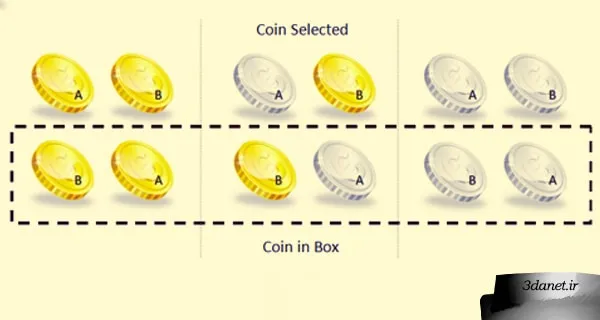
Bertrand's Box Paradox: we have three boxes, one of which contains two gold coins (the G.G. box). The second box contains two silver coins (the S.S. box), and the third box contains one gold coin and one silver coin (the G.S. box). Each box is divided into two halves, and you can open each half separately; one coin has been placed in each half. You must choose one of the three boxes at random. What is the chance that you will choose the box containing two coins of different colors? The answer is clear: one-third. But suppose that when you open the first half of one of the boxes, you discover that it contains a gold coin. In that case, this box is either G.G. or G.S., and consequently, it seems the chance that this box is G.S. is one-half. Similarly, if the coin in the first half of the box you open is silver, then your box is either S.S. or G.S., and in this case too, the chance of this box being G.S. is one-half. This is while the first coin you lay eyes on is either a gold coin or a silver coin. So there is no alternative but for the chance of any box you choose being G.S. to be one-half and not one-third. It is clear that the chance of selecting the box whose coins are not of the same color is one-third and nothing else. The problem is to find the flaw in the reasoning above. As Bertrand himself said, there is a fallacy at work, namely the assumption that if the coin hidden in the first half of the box you choose is gold, the probability that the coin hidden in the other half is gold is equal to the probability that it is silver. But this assumption is incorrect, and the probability that the coin inside the other half is silver is lower. If the box you have chosen is G.G., the probability that you will immediately lay eyes on a gold coin is twice the probability when your chosen box is G.S. Consequently, seeing that one of the coins is gold indicates that the probability of the chosen box being G.G. is twice the probability of it being G.S. Likewise, one of the coins being silver indicates that the probability of the chosen box being S.S. is twice the probability of it being G.S. Suppose we make a selection 3000 times under conditions where the coins are returned to the boxes and the options are thoroughly mixed out of your sight. Each time you pick up one of the boxes, you look at the first coin, and that coin is inevitably either gold or silver. If you accept that fallacious reasoning for each choice, you will expect to choose G.S. approximately 1500 times. But you would be mistaken. In reality, approximately 2000 of your choices will be same-color options (i.e., G.G. or S.S.), and only a thousand of your choices will be G.S. Joseph Bertrand was a mathematician who published his book, titled Calcul des probabilités, in 1889.
.
.
Bertrand's Box Paradox
(Translation by Kaveh Behbahani from the book Paradoxes: From A to Z, Michael Clark, Routledge, pp. 20-21)
.
.




Discussion3 comments
دوست عزیز، در نوشتار بالا حرف "ط" نمایندهی طلا و حرف "ن" نمایندهی نقره است. و گمان نمیکنم تغییر دادنشان به هیچ حرف و عدد و نماد دیگری، تاثیری بر پیچیدهتر یا سادهتر شدن فهم مساله داشته باشد.
چرا ط ن و ط ط و ط ن ؟ نمیشد از a b استفاده کرد ؟ و اینقدر به پیچیده تر شدن پارادوکس کمک نکرد ؟
جناب کوروش عزیز! ط مخفف طلا و ن مخفف نقره است و خیلی بهتر در ذهن تداعی میشه تا بگوییم که a مساوی است با طلا و b مساوی است با نقره. در فرض شما، ذهن ابتدا باید بفهمد که a چه بوده و b چه بوده، اما در فرض بالا نیاز به محاسبه نداره ط یعنی طلا ، و ن یعنی نقره