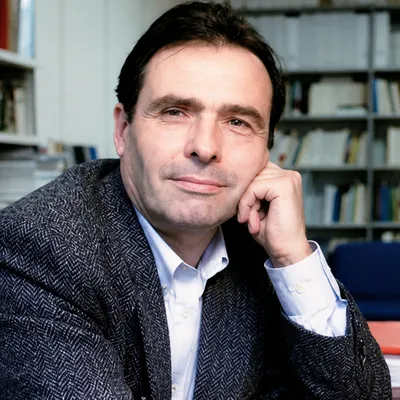
Foreign thinker
Pierre Bourdieu
Gottlob FregePhilosophy of logic and philosophy of languageGerman1930–2002
"The social must be understood through its history."
In their times
Open in the Timeline of Thought


Life and Thought
Gottlob Frege was a German philosopher, logician, and mathematician and one of the founders of analytic philosophy in the twentieth century. Through his works on mathematical logic, philosophy of language, and the foundations of mathematics, he had a profound influence on thinkers such as Bertrand Russell, Ludwig Wittgenstein, and the analytic philosophical tradition.
Gottlob Frege was born in 1848 in Wismar, Germany. He studied at the universities of Jena and Göttingen and spent most of his professional career as a professor of mathematics at the University of Jena. His early interest in the foundations of mathematics gradually led to the development of one of the most important philosophical traditions of modern times: analytic philosophy.
Frege’s most important work, Begriffsschrift, was published in 1879. In this work, he introduced a new system of formal logic that represented a major step beyond traditional Aristotelian logic toward modern logic. He attempted to show that much of mathematics could be explained on the basis of logical principles.
Frege also made major contributions to philosophy of language. In his famous essay “On Sense and Reference,” he introduced the fundamental distinction between “sense” (Sinn) and “reference” (Bedeutung), a distinction that became central in later philosophy of language. He also examined the concept of thought as an objective content independent of individual minds.
Frege’s project in The Foundations of Arithmetic to reduce arithmetic to logic faced serious difficulties, especially after Russell’s paradox. Nevertheless, his work established foundations for modern logic, contemporary philosophy of language, and a major part of analytic philosophy.