Foreign thinker
Jurgen Habermas
Jurgen HabermasPhilosophy and SociologyGerman1929–2026
Modernity is an unfinished project.
In their times
Open in the Timeline of ThoughtInfluenced3


Influenced by8


Critiqued2


Critics1

Contemporaries9


Life and Thought
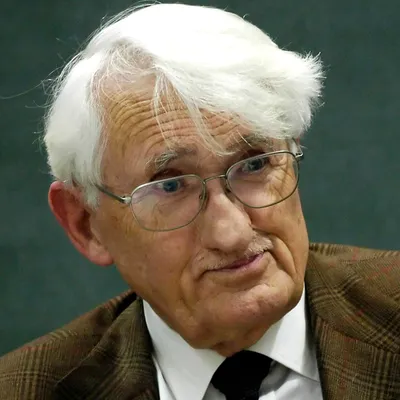
Jürgen Habermas (1929–2026) was a German philosopher and social theorist, and one of the leading figures of the Frankfurt School. By introducing concepts such as the public sphere and communicative action, he had a profound impact on philosophy, sociology, and liberal democracy.
Jürgen Habermas, a German philosopher and social theorist, was one of the most important figures in philosophy and the social sciences after the Second World War. He is usually associated with the second generation of critical theory and the tradition of the Frankfurt School, although his thought cannot be reduced to this framework alone and has also been influenced by pragmatism, the philosophy of language, sociology, Kant, Marx, and the liberal democratic tradition.
Habermas was born on June 18, 1929, in Düsseldorf and grew up in Gummersbach. His adolescent experience in Nazi Germany and his post-war awareness of the crimes of Nazism were among the foundational points shaping his political and ethical outlook. He later came to see democracy, rational dialogue, and public critique not merely as theoretical concepts but as conditions for preventing a return to authoritarianism. The Stanford Encyclopedia of Philosophy also emphasizes the role of the 1945 experience in shaping his intellectual horizon.
Habermas studied at the universities of Göttingen, Zurich, and Bonn, and wrote his doctoral dissertation on Schelling. In 1956, he joined the Frankfurt Institute for Social Research and served as Theodor Adorno's assistant for several years. He then wrote his habilitation thesis in Marburg, titled The Structural Transformation of the Public Sphere; this work was published in 1962 and established his name in social theory.
The concept of the 'public sphere' is one of Habermas's most famous concepts. He viewed this sphere as a space between the state, the market, and private life—a place where citizens discuss public issues, public opinion is formed, and political power can gain legitimacy through dialogue and rational critique. In his view, late capitalism, commercial media, and economic interests have diverted this sphere from its critical and participatory state.
In the following years, Habermas taught at the University of Heidelberg and then at the University of Frankfurt. From 1971, he took over the directorship of the Max Planck Institute in Starnberg, and it was during this period that he laid the groundwork for writing his magnum opus, The Theory of Communicative Action. This book was published in 1981, and in it, Habermas presented a theory of communicative rationality: a reason that reveals itself not in domination, instrumentalization, or individual interest, but in free, reasoned, and intersubjective dialogue.
Among his other important concepts are 'discourse ethics,' 'deliberative democracy,' 'lifeworld and system,' 'the colonization of the lifeworld,' 'constitutional patriotism,' 'post-metaphysical thinking,' and 'post-secular society.' Habermas also always remained a public intellectual, intervening in debates such as Germany's Nazi past, German reunification, the future of Europe, religion in the public sphere, genetic engineering, and the crises of democracy.
Habermas traveled to Iran in May 2002 and gave lectures at the University of Tehran, Shiraz University, and the Iranian Institute of Philosophy. This visit had a wide resonance in Iran's intellectual sphere, particularly due to his attention to the relationship between religion, secularism, public rationality, and democracy.
Habermas died on March 14, 2026, in Starnberg, at the age of 96. His publisher, Suhrkamp, announced his death, and media outlets such as The Guardian described him as one of the most influential philosophers of the twentieth century.