There is nothing outside the text.
In their times
Open in the Timeline of ThoughtInfluenced9


Influenced by6


Students1

Critiqued1

Critics4


Contemporaries7


Life and Thought
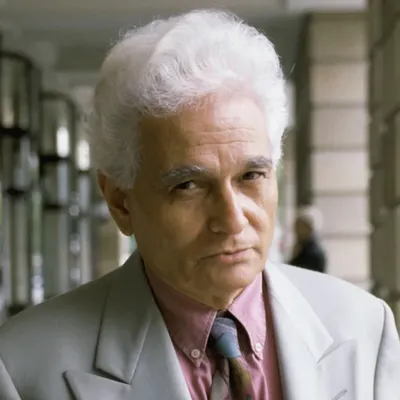
Jacques Derrida (1930–2004) was a French philosopher of Algerian descent and one of the most influential figures in contemporary philosophy and post-structuralist thought. His name is inextricably linked with the concept of "deconstruction," which transformed the way we read texts, meaning, and the Western philosophical tradition.
Jacques Derrida, born July 15, 1930, and died October 8, 2004, was a French philosopher of Algerian descent and one of the most influential figures in contemporary philosophy, literary theory, and post-structuralist thought. His name is above all linked with the concept of "deconstruction"; an approach that transformed the way we read texts, meaning, language, and the Western philosophical tradition.
Derrida was born in Algeria and spent his childhood and adolescence in the complex cultural and historical atmosphere of that land. He later moved to France and, within the academic environment of Paris, engaged with philosophy, literature, linguistics, and phenomenology. His deep familiarity with Plato, Husserl, Heidegger, Rousseau, Nietzsche, and Freud played a role in shaping his distinctive intellectual style.
Derrida's thought is founded on questioning the relationship between language and meaning, text and interpretation, presence and absence, speech and writing. He demonstrated that meaning is not a fixed and closed entity, but is formed within a network of differences, references, and readings. For this reason, his works have had a profound impact on philosophy as well as on literary criticism, cultural studies, art theory, and the humanities.
Derrida's cultural significance lies in his transformation of reading into a questioning act. He blurred the boundary between philosophy and literature and showed that every text, even classical philosophical texts, possesses hidden layers, internal tensions, and new possibilities for interpretation.
Bibliography
Writings and transcribed lectures24 titles
Speech and Phenomena
Writing and Difference
Of Grammatology
Seed-Scattering / Fruit-Bearing
Marginalia: On Philosophy
Positions
The Sound of Sorrow
The Goads: Nietzsche's Methods
Reality in Painting
Postcard: From Socrates to Freud and Beyond
Atraf / The Coasts
On Spirit: Heidegger and the Question
Memories for Paul de Man
The Problem of Genesis in Husserl's Phenomenology
Another Path
Specters of Marx
The Politics of Friendship
Faith and Knowledge
On Hospitality
Goodbye, Emmanuel Levinas
Tomorrow, what will be...?
The Wicked: Two Treatises on Reason
The Concept of September 11
The Rhetoric of Darwin