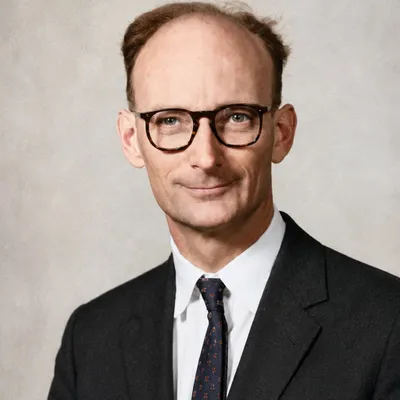
Foreign thinker
John Langshaw Austin
John Langshaw AustinPhilosophy of language and speech act theoryBritish1911–1960
“The total speech act in the total speech situation is the only actual phenomenon which, in the last resort, we are engaged in elucidating.”


Life and Thought
John Langshaw Austin was a British philosopher and one of the leading figures of twentieth-century ordinary language philosophy. By demonstrating that speaking can itself constitute a form of action, he laid the foundations of speech act theory. His distinction among locutionary, illocutionary, and perlocutionary acts has had a lasting influence on the philosophy of language, linguistics, and communication studies.
John Langshaw Austin was born in Lancaster, England, on March 26, 1911. He studied classics, ancient history, and philosophy at Shrewsbury School and later at Balliol College, Oxford. Austin became a fellow of All Souls College in 1933 and began teaching and conducting research at Magdalen College, Oxford, in 1935.
During the Second World War, Austin served in British military intelligence and contributed to the collection and analysis of information connected with the Normandy operations. After the war, he returned to Oxford and was appointed White’s Professor of Moral Philosophy in 1952. His weekly meetings at Oxford, where participants collectively examined the precise uses of ordinary words, played an important role in the development of ordinary language philosophy.
Austin’s philosophical method was founded on a meticulous examination of everyday language. He believed that distinctions embedded in ordinary usage reflected the accumulated experience of generations and could protect philosophers from hasty generalizations and pseudo-problems. He applied this method to questions concerning knowledge, perception, truth, action, responsibility, excuses, and freedom.
Austin’s most important achievement was his theory of speech acts. He demonstrated that many utterances do not merely describe facts but also perform actions. For example, by saying “I promise,” a person does not simply report a promise but makes one. Austin eventually abandoned the simple distinction between constative and performative utterances and distinguished three dimensions of speaking: the locutionary act of producing a meaningful expression; the illocutionary act performed in saying something, such as promising, ordering, or warning; and the perlocutionary act consisting in the effects produced on an audience, such as persuading or alarming.
Austin presented most of his work in lectures and articles and died of lung cancer on February 8, 1960, at the age of forty-eight. His principal books were published posthumously: Philosophical Papers, How to Do Things with Words, and Sense and Sensibilia. His thought was developed further in speech act theory, particularly by John Searle, and has influenced the philosophy of language, pragmatics, linguistics, literary theory, law, and communication studies.