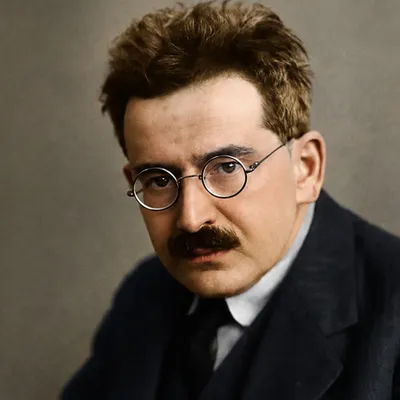
Foreign thinker
Walter Benjamin
Walter BenjaminPhilosophy of history, literary criticism, aestheticsGerman1892–1940
“Every document of civilization is also a document of barbarism.”


Life and Thought
Walter Benjamin was a German-Jewish philosopher, literary critic, cultural theorist, and writer who is considered one of the most influential thinkers of the twentieth century. His writings on history, art, modern experience, media, and the critique of capitalism have had a broad impact on critical theory, cultural studies, and aesthetics.
Walter Benjamin was born in Berlin in 1892 into a Jewish middle-class family. He studied philosophy, German literature, and art history at the universities of Freiburg, Berlin, Munich, and Bern, and wrote his doctoral dissertation on the concept of artistic criticism in German Romanticism. After failing to obtain an academic position, he worked as an independent writer, translator, and critic.
Benjamin was closely connected with Marxist intellectual circles and thinkers such as Theodor Adorno and the Frankfurt School, although his thought combined Marxism, Jewish theology, Romanticism, and philosophy of history in a distinctive way. He examined modern experience, the role of technology in art, and transformations in human perception.
Among his most important works are The Work of Art in the Age of Mechanical Reproduction, Theses on the Philosophy of History, The Origin of German Tragic Drama, and his writings on nineteenth-century Paris. His concept of the “aura” in the analysis of art and media, as well as his critique of linear and progressive views of history, remain among his most influential ideas.
After the rise of Nazism, Benjamin went into exile and died in 1940 while attempting to escape occupied France at the Spanish border. His writings gained wide recognition after his death and continue to be studied in philosophy, literary theory, media studies, and cultural criticism.