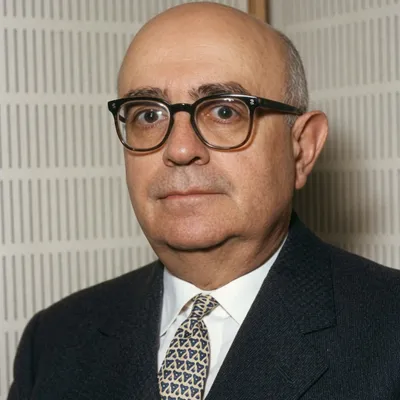
Wrong life cannot be lived rightly.
Life and Thought
Theodor Adorno (1903–1969) was a prominent German sociologist, philosopher, and musicologist, and one of the leading figures of the Frankfurt School. Together with Max Horkheimer, by formulating "Critical Theory" and the concept of the "Culture Industry," he critiqued modernity, instrumental rationality, and the system of domination in capitalist societies. His work "Dialectic of Enlightenment" is considered one of the most important philosophical and sociological texts of the twentieth century.
Theodor Wiesengrund Adorno was born in 1903 in Frankfurt, Germany. Raised in a family with a deep appreciation for art, he pursued professional studies in musicology and composition alongside philosophy and sociology; an interest that remained a prominent presence in all his cultural and philosophical analyses until the end of his life. Adorno joined the Frankfurt Institute for Social Research in the 1930s, but with the rise of the Nazi regime and because of his Jewish ancestry, he was forced to emigrate to England and then to the United States of America.
The experience of emigrating to America and observing Western consumer societies, alongside the catastrophe of the Holocaust in Europe, formed the central axis of his thought. In his joint masterpiece with Max Horkheimer, the book "Dialectic of Enlightenment" (1947), Adorno demonstrated how Enlightenment rationality, which was supposed to free humanity from ignorance and fear, had itself turned into a form of instrumental rationality and new domination. They introduced the concept of the "Culture Industry" to show how art and culture in modern societies have been transformed into standardized, mass-produced commodities for suppressing critical thought and entertaining the masses.
After returning to Germany in the post-war period, Adorno wrote his other major work, "Negative Dialectics" (1966), in which he rejected any form of absolute philosophical systematization (such as the systems of Hegel and Kant) and emphasized the necessity of constant critique, attention to non-essential particulars, and a departure from intellectual totalitarianism. He also famously stated that "To write poetry after Auschwitz is barbaric," reflecting on the moral and intellectual responsibility of art and philosophy in a post-catastrophe world. Adorno died in Switzerland in 1969.