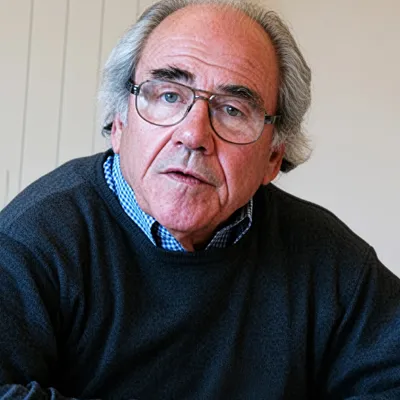
Foreign thinker
Jean Baudrillard
Jean BaudrillardPostmodern philosophy and media theoryFrench1929–2007
The simulacrum is never that which conceals the truth; it is the truth which conceals that there is none. The simulacrum is true.


Life and Thought
Jean Baudrillard was a French philosopher, sociologist, and cultural theorist, best known for his analyses of consumer society, media, signs, and simulated reality. In works such as The Consumer Society, For a Critique of the Political Economy of the Sign, and Simulacra and Simulation, he argued that in the contemporary world signs and images do not merely represent reality but come to replace it. Concepts such as “simulacrum,” “simulation,” and “hyperreality” secured his place in cultural theory and postmodern thought.
Jean Baudrillard was born on 27 July 1929 in Reims, France. He first studied German language and literature, and before entering sociology and philosophy in a sustained way, he translated works by German writers. In the 1960s, Baudrillard became engaged with the French intellectual scene, Marxism, structuralism, semiotics, and the critique of consumer society, and wrote his doctoral dissertation under the supervision of Henri Lefebvre.
Baudrillard’s early works, such as The System of Objects and The Consumer Society, focused on the idea that consumption in modern society is not merely a response to material needs, but a system of signs and social distinctions. In For a Critique of the Political Economy of the Sign, he sought to connect Marxist analysis of value with semiotics, arguing that commodities possess not only use value and exchange value, but also “sign value”: they function within a network of meanings and social positions.
In his later phase, Baudrillard moved from the critique of consumer society to the theory of simulation and hyperreality. In Simulacra and Simulation, he argued that in the new media and technological world, the boundary between reality and representation collapses, and signs can operate independently of reality. For him, “hyperreality” names a condition in which images, models, media, and signs become more powerful and effective than reality itself.
In works such as America, The Gulf War Did Not Take Place, and Symbolic Exchange and Death, Baudrillard also analyzed politics, media, capitalism, technology, and contemporary culture in a sharp, ironic, and sometimes controversial style. His importance lies in having moved the language of social criticism beyond classical frameworks of production and class toward the analysis of signs, images, consumption, media, and fabricated reality. Baudrillard died in Paris on 6 March 2007, but his concepts remain influential in philosophy, sociology, media studies, contemporary art, and the critique of digital culture.