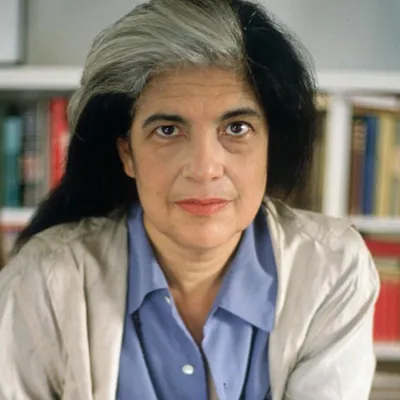
Foreign thinker
Susan Sontag
Susan SontagEssay writing, cultural criticism, and aesthetic theoryAmerican1933–2004
In place of a hermeneutics, we need an erotics of art.


Life and Thought
Susan Sontag was an American writer, essayist, and cultural critic who became one of the most influential intellectual voices in the United States in the second half of the twentieth century with her book Against Interpretation (1966). In works such as On Photography and Illness as Metaphor she examined the relationship between image, language, and human experience, while also working as a novelist and filmmaker.
Susan Sontag was born on January 16, 1933, in New York City and spent part of her childhood in Tucson, Arizona, and Los Angeles. She completed her undergraduate studies at the University of Chicago, then pursued graduate work in philosophy, literature, and theology at Harvard University and St Anne's College, Oxford. In the early 1960s she taught philosophy at several institutions, including Columbia University, before soon turning from academia to independent writing.
Sontag's reputation was built in the early 1960s through essays published in journals such as Partisan Review and The New York Review of Books, later collected in Against Interpretation (1966). In its title essay, she challenged interpretation-driven approaches to art and called instead for attention to the immediate, sensory experience of the work itself. This book, along with her celebrated essay "Notes on Camp," established her as a leading figure of New York's intellectual scene.
In the following decades she produced other influential works: On Photography (1977) examines how photographic images shape our understanding of reality and won the National Book Critics Circle Award; Illness as Metaphor (1978), written after her own first experience with cancer, critiques the military and moral metaphors language uses to describe illness; and Regarding the Pain of Others (2003), her last major work of nonfiction, reconsiders how images of violence and war function in the collective conscience. She also wrote novels such as The Volcano Lover and In America (which won the National Book Award in 2000), and directed several feature films.
Alongside her literary work, Sontag was also known as a public figure — for her trip to Hanoi during the Vietnam War and her outspoken political positions on the Balkan wars, among other things. She died in New York City on December 28, 2004, from complications of leukemia.
Sedanet articles about Susan Sontag