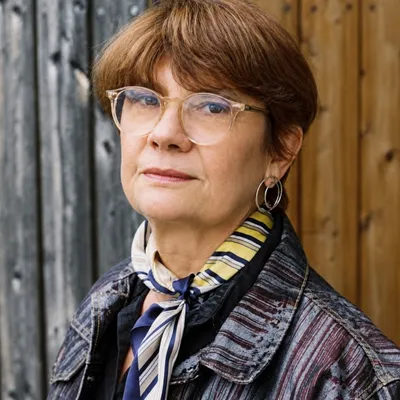
Foreign thinker
Catherine Malabou
Catherine MalabouContinental Philosophy and Philosophy of NeuroscienceFrenchb. 1959
In their times
Open in the Timeline of Thought


Life and Thought
Catherine Malabou (born 1959) is a French philosopher and former student of Jacques Derrida who, through her formulation of the concept of "plasticity" — drawn from Hegel and neuroscience — has become one of the most influential figures in contemporary Continental philosophy. By bridging philosophy, psychoanalysis, and neuroscience, she has charted a path distinct from Derridean deconstruction.
Catherine Malabou was born on 18 June 1959 in Sidi Bel Abbès, in French colonial Algeria. She began her philosophical studies at the École Normale Supérieure in Fontenay-aux-Roses and joined Jacques Derrida's seminar circle. Her doctoral thesis on Hegel, supervised by Derrida, was defended in 1994 at the École des Hautes Études en Sciences Sociales (EHESS) and published in 1996 as L'Avenir de Hegel: Plasticité, Temporalité, Dialectique (The Future of Hegel: Plasticity, Temporality, Dialectic), accompanied by a substantial preface by Derrida.
In this work, Malabou extracted the concept of "plasticity" from Hegel's Phenomenology of Spirit: the simultaneous capacity to receive form, to give form, and to explode or destroy form. She presented this concept not merely as an interpretive tool for reading Hegel, but as an ontological alternative to the structuralist and deconstructionist concepts prevalent in French philosophy. In 1999, Malabou co-authored Counterpath with Derrida.
From the early 2000s, Malabou increasingly turned toward neuroscience and biomedicine. In her influential book What Should We Do with Our Brain? (2004), she became the first major philosopher in the Continental tradition to seriously engage with findings on neuroplasticity — the brain's physical malleability — showing how this biological concept could enrich the philosophical concept of plasticity, while also warning against the ideological mobilization of this concept in the service of neoliberal capitalism (particularly in the discourse of labor "flexibility").
In other works such as Le Change Heidegger, Malabou reread Heidegger's ontology, and in Ontology of the Accident (2009) she introduced the concept of brain injury and trauma into philosophical debates on identity and subjecthood, drawing on clinical evidence from brain-damaged patients to argue for the possibility of a complete rupture in identity as opposed to the continuous persistence of the subject. In Before Tomorrow: Epigenesis and Rationality (2014), she critiqued the Kantian concept of the a priori from the perspective of evolutionary biology and epigenetics. She currently serves as Professor of Modern European Philosophy at the Centre for Research in Modern European Philosophy (CRMEP) at Kingston University London and as a professor at the University of California, Irvine.
Although Malabou was profoundly shaped by Derrida and deconstruction early in her career, her intellectual trajectory gradually marked a clear break from this tradition — a break rooted in her engagement with neuroscience and her effort to construct a plastic ontology in place of a Derridean, text-centered philosophy.