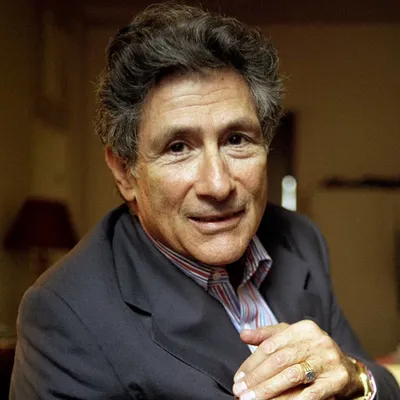
Foreign thinker
Edward Said
Edward SaidLiterary theory, postcolonial studies, cultural criticismPalestinian-American1935–2003
"Orientalism is less about the East than it is about the relationship between power and knowledge."
In their times
Open in the Timeline of Thought


Life and Thought
Edward Said was a Palestinian-American literary theorist, cultural critic, and university professor who is recognized as one of the founders of postcolonial studies. His influential book Orientalism had a profound impact on critiques of Western representations of the East and on contemporary cultural, literary, and political studies.
Edward Said was born in 1935 in Jerusalem into a Palestinian Christian family. He spent his childhood and adolescence between Palestine, Egypt, and the United States, and continued his higher education at Princeton and Harvard. From 1963 until the end of his life, he was a professor of English and comparative literature at Columbia University.
Said's most important work, Orientalism (1978), examined how Western knowledge, literature, and political discourses about the "East" were often shaped in relation to colonial power structures. He analyzed Orientalism as a set of practices of representation and knowledge production about the East and showed how these representations influenced Western perceptions of Eastern societies.
Other major works include Culture and Imperialism, Representations of the Intellectual, and The Question of Palestine. In addition to his academic work, Said was a prominent advocate for Palestinian rights and wrote and spoke about colonialism, exile, identity, and the role of the intellectual in contemporary society. His thought remains influential in literary theory, postcolonial studies, and cultural criticism.