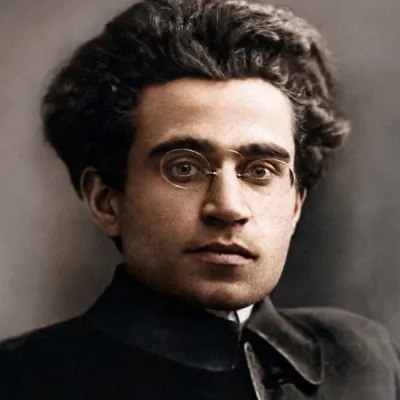
Foreign thinker
Antonio Gramsci
Antonio GramsciPolitical Philosophy and MarxismItalian
Pessimism of the intellect, optimism of the will.
Life and Thought
Antonio Gramsci (1891–1937) was a philosopher, political theorist, and one of the founders of the Italian Communist Party. He is known for developing the theory of cultural hegemony and analyzing the role of intellectuals in reproducing power structures. His notes written during his imprisonment under fascism, published as the Prison Notebooks, had a profound impact on twentieth-century political philosophy, sociology, and cultural studies.
Antonio Gramsci was born in 1891 in Sardinia, Italy. In his youth, he went to the University of Turin to study linguistics and literature, but was soon captivated by labor movements and political struggles. Observing the social transformations after World War I and the rise of council movements in Turin, Gramsci became a key figure of the Italian left and played a role in founding the Italian Communist Party in 1921.
In 1926, with the establishment of Benito Mussolini's fascist regime, Gramsci was arrested despite his parliamentary immunity and sentenced to twenty years in prison. The fascist court prosecutor famously declared: "We must stop this brain from functioning for twenty years." Nevertheless, under the harshest physical and mental conditions in prison, Gramsci continued to write, producing a vast collection of philosophical, historical, and political analyses that were later compiled and published as 33 notebooks under the title Prison Notebooks (Quaderni del carcere).
Gramsci's most important theoretical approach was a revision of orthodox Marxism and a critique of economic dogmatism. He demonstrated that ruling-class domination is exercised not only through economic power and the repressive apparatuses of the state (such as the police and army) but also requires cultural hegemony—that is, the voluntary acceptance of the dominant class's values and worldview by various strata of society through civil institutions like education, media, and religion. He also introduced the concept of "organic intellectuals" and emphasized the importance of cultural and ideological struggle for the fundamental transformation of society. Gramsci died in 1937, shortly after his release from prison, due to malnutrition and multiple illnesses.