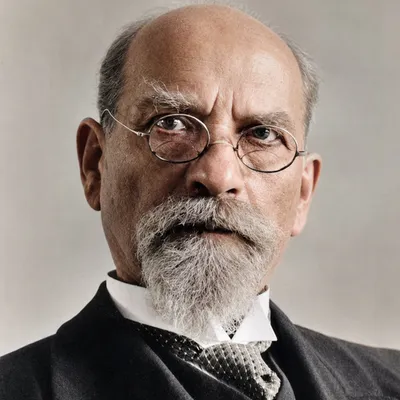
To the things themselves!
In their times
Open in the Timeline of ThoughtInfluenced11


Influenced by2


Students1

Teachers2


Same school1

Contemporaries1

Life and Thought
Edmund Husserl was a German-Austrian philosopher and the founder of phenomenology, considered one of the most influential philosophers of the twentieth century. His thought played a significant role in shaping movements such as existentialism and hermeneutics.
Edmund Husserl, born April 8, 1859, and died 1938, was a German-Austrian philosopher and the founder of phenomenology. He is considered one of the most influential philosophers of the twentieth century, and his thought played a significant role in shaping movements such as existentialism, hermeneutics, continental philosophy, and new theories of consciousness and experience.
Husserl was born in Prossnitz, Moravia, and initially pursued his studies in mathematics. He studied at the universities of Leipzig, Berlin, and Vienna, and wrote his doctoral dissertation in pure mathematics. His acquaintance with Franz Brentano, the Austrian philosopher and psychologist, shifted his intellectual path toward philosophy and the analysis of consciousness.
Initially, Husserl was interested in the relationship between mathematics, logic, and psychology, but later, in his important book Logical Investigations, he criticized psychologism and sought to provide a rigorous and independent foundation for logic and knowledge. By proposing phenomenology, he directed philosophy toward the precise description of conscious experience, meaning, perception, and the human relationship with the world.
Husserl taught at the universities of Göttingen and Freiburg, and important students and intellectual companions such as Martin Heidegger, Edith Stein, and Emmanuel Levinas were influenced by his intellectual atmosphere. Husserl's cultural significance lies in the fact that he steered philosophy toward a rethinking of lived experience, consciousness, and the way the world appears to humans.
Bibliography
Writings and transcribed lectures9 titles
On the Concept of Number: Psychological Analyses
Philosophy of Arithmetic: Psychological and Logical Investigations
Logical Investigations
Ideas for a Pure Phenomenology and Phenomenological Philosophy
Cartesian Meditations: An Introduction to Phenomenology
Formal Logic and Transcendental Logic
The Crisis of European Sciences and Transcendental Phenomenology
Experience and Judgment
Lectures on Internal Time-Consciousness