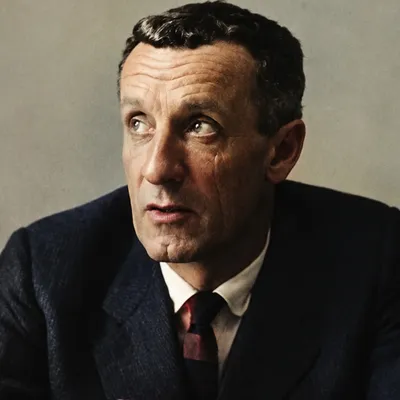
Foreign thinker
Maurice Merleau-Ponty
Maurice Merleau-PontyPhenomenology, philosophy of perception, and embodimentFrench1908–1961
“The body is our general medium for having a world.”


Life and Thought
Maurice Merleau-Ponty was a French philosopher and one of the most important figures of twentieth-century phenomenology. His thought focused on lived experience, sensory perception, and the role of the body in shaping consciousness. By emphasizing the fundamental connection between human beings and the world, he challenged the traditional dualism of mind and body and deeply influenced contemporary philosophy, the humanities, and theories of embodiment.
Maurice Merleau-Ponty was born in 1908 in Rochefort, France. He studied at the École Normale Supérieure in Paris and later taught and researched philosophy. His intellectual development took place within twentieth-century French philosophy, especially under the influence of Edmund Husserl’s phenomenology and existentialist thought.
In his works, Merleau-Ponty sought to explain human experience not through a mind separated from the world, but through the lived relationship between human beings, their environment, the body, and others. His major work, Phenomenology of Perception (1945), argues that the body is not merely a physical object but the primary way through which we are present in the world and perceive reality.
He also explored the relationship between consciousness, nature, and history in works such as The Structure of Behavior and his later writings on language, art, politics, and ontology. Alongside Jean-Paul Sartre and Simone de Beauvoir, he was a major figure in postwar French philosophy, although he later distanced himself from some of Sartre’s positions.
Merleau-Ponty’s ideas had a profound influence on philosophy of mind, cognitive science, body studies, Gestalt psychology, and social theory. He died in Paris in 1961, and his works remain important sources in contemporary philosophy.