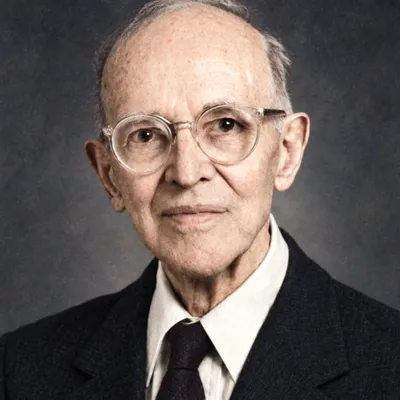
Foreign thinker
Charles Hartshorne
Charles HartshornePhilosophy of Religion, Process Metaphysics, and Process TheologyAmerican1897–2000
In their times
Open in the Timeline of Thought


Life and Thought
Charles Hartshorne (1897–2000) was an American philosopher of religion and metaphysics, and the foremost figure in the development of "process theology." Through his formulation of panentheism — a conception of God as both transcendent and encompassing the world, transformed through interaction with it — and his revival of Anselm's ontological argument in modal logic, he challenged classical theology.
Charles Hartshorne was born on 5 June 1897 in Kittanning, Pennsylvania; his father was an Episcopal minister. After serving as a medical orderly in the First World War, he went to Harvard University, earning his doctorate in philosophy in 1923. He then spent two years in Germany studying under Edmund Husserl and Martin Heidegger, becoming acquainted with phenomenology.
Returning to Harvard, Hartshorne served as a research assistant and co-edited six volumes of the Collected Papers of Charles Sanders Peirce — work that deeply acquainted him with American pragmatism. During the same period, he worked as an assistant to Alfred North Whitehead in the final years of Whitehead's teaching at Harvard. Although Hartshorne always maintained that he had developed his core ideas before encountering Whitehead, his intellectual affinity with Whitehead was so profound that the two are counted together as the founders of "process philosophy."
Hartshorne taught at the University of Chicago from 1928 to 1955, then at Emory University, and from 1962 until the end of his life at the University of Texas at Austin. His most significant innovation in the philosophy of religion was his systematic formulation of "dipolar theism" or panentheism: against the classical conception of God as wholly immutable, self-sufficient, and impassible, Hartshorne argued that God is necessary and absolute in his abstract essence, yet relative, affected, and in process in his concrete existence — meaning that the suffering and joy of creatures genuinely affect him. This conception, he held, is more consistent both with religious experience and with logical coherence.
His major works include The Divine Relativity (1948), Reality as Social Process (1953), The Logic of Perfection (1962), and Creative Synthesis and Philosophic Method (1970). In Anselm's Discovery and related writings, Hartshorne sought to reconstruct Saint Anselm's ontological argument in modal logic, arguing that if God's existence is possible at all, then it is necessary — a revival that sparked extensive debate in analytic philosophy of religion and which Alvin Plantinga also engaged with in his own formulation of the modal ontological argument.
Hartshorne also had a remarkable devotion to ornithology and wrote Born to Sing on birdsong and the question of aesthetic pleasure in animals — a topic connected to his panpsychism, the belief that every actual unit of reality possesses some degree of experience and feeling. He died on 9 October 2000 in Austin, at the age of 103.