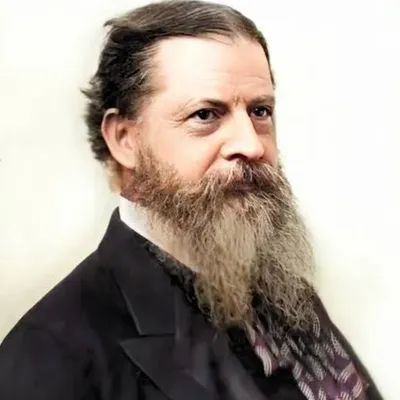
Foreign thinker
Charles Sanders Peirce
Charles Sanders PeircePragmatist philosophy, logic, and semioticsAmerican1839–1914
“The meaning of an idea is the set of its practical consequences.”
In their times
Open in the Timeline of Thought


Life and Thought
Charles Sanders Peirce was an American philosopher, logician, and scientist and one of the founders of pragmatism. He is also regarded as one of the most important theorists of modern semiotics, with a profound influence on the philosophy of language, logic, and cognitive science.
Charles Sanders Peirce was born in 1839 in Cambridge, Massachusetts, USA. The son of Benjamin Peirce, a prominent Harvard mathematician, he became familiar with mathematics, logic, and the natural sciences from an early age. He studied at Harvard University and later worked for many years as a scientist at the United States Coast Survey.
Peirce was one of the founders of American pragmatism, a philosophical approach that emphasizes clarifying the meaning of concepts through their practical consequences. Unlike simplified interpretations of pragmatism, he understood it as a method of rational inquiry and the pursuit of truth. His ideas later influenced philosophers such as William James and John Dewey.
One of Peirce’s most important contributions was the development of the theory of signs, or semiotics. He analyzed signs through the triadic relation of sign, object, and interpretant, offering a systematic account of meaning and interpretation. His work in logic, especially on induction, reasoning, and scientific method, is also highly significant.
Among his important works are the collections of his writings published after his death, especially Collected Papers of Charles Sanders Peirce. Although he was not widely recognized during his lifetime, in the twentieth century he became a foundational figure in analytic philosophy, modern logic, and semiotics.