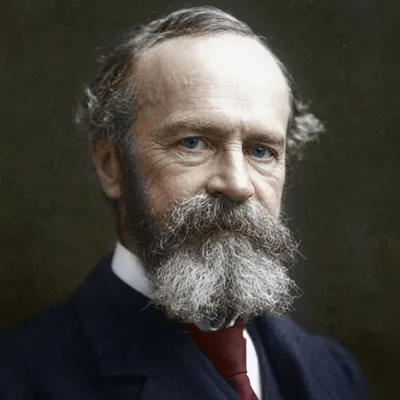
Foreign thinker
William James
William JamesPhilosophy and PsychologyAmerican1842–1910
Our belief at the beginning of a doubtful undertaking is the one thing that ensures the successful outcome of your undertaking.
In their times
Open in the Timeline of Thought



Life and Thought
William James (1842–1910) was an American philosopher, psychologist, and physician, and one of the founders of the school of pragmatism. With works such as The Principles of Psychology and The Varieties of Religious Experience, he had a profound impact on functionalist psychology and the philosophy of religion.
William James (January 11, 1842 – August 26, 1910) was an American philosopher, psychologist, and physician. He is considered one of the founders of pragmatism, a major figure in functionalist psychology, and one of the most important American thinkers of the late nineteenth and early twentieth centuries. James moved between physiology, psychology, philosophy, religious studies, and lived experience, and this very breadth lifted his works out of the dry academic mold.
James was born in New York into a wealthy, cultured family. His father, Henry James Sr., was a religious thinker with an interest in Swedenborgian mysticism. His younger brother, Henry James, later became one of the greatest novelists in the English language. William and Henry received a scattered, international education in childhood and adolescence and lived for a time in Europe. This movement between America and Europe broadened James's intellectual horizon from the start.
James was initially interested in painting and then the natural sciences, but he ultimately studied at Harvard Medical School and earned his medical degree, though he never practiced medicine professionally. At Harvard, he first taught physiology and anatomy, then turned to psychology, and finally to philosophy. James was among the first to teach psychology academically and experimentally in America and played an important role in the formation of Harvard's psychology department.
His most important psychological work is The Principles of Psychology, a monumental book published in 1890 and considered a classic in the history of psychology. In this book, James examined concepts such as the "stream of consciousness," habit, attention, will, emotion, the self, and religious experience with clear, analytical prose. His view of the mind was dynamic and alive: the mind is not a fixed container but a continuous stream of experiences, attentions, and choices.
In philosophy, James is best known for pragmatism. The term pragmatism was first proposed by Charles Sanders Peirce, but James expanded and popularized it. In James's view, the meaning of an idea must be sought in its practical consequences. For him, truth is not something solid and external to life; beliefs find meaning within the context of experience, action, needs, and human results. Of course, by usefulness, James did not mean mere personal benefit or short-term expediency, but rather the efficacy of a belief in life, experience, and understanding the world.
Against closed, absolutist philosophical systems, James defended an open, pluralistic, and ever-becoming world. He opposed rigid rationalism and narrow empiricism and sought to understand experience in its broadest sense—an experience that also encompasses feeling, will, faith, suffering, the body, action, and relationship with the world. This view in his philosophy is known as "radical empiricism."
Another of James's important works is The Varieties of Religious Experience, a book derived from his Gifford Lectures in Edinburgh. In this work, instead of focusing on religious institutions and official theology, James addresses individual religious experience, faith, prayer, mysticism, saintliness, and borderline psychological states. This book remains a classic in the psychology of religion and religious studies.
In The Will to Believe, James defended the idea that in certain existential situations, a person is compelled to decide and believe before attaining complete certainty. He did not seek to discard rationality but argued that human life does not always wait for conclusive proof; sometimes faith, choice, and commitment are part of the very path to understanding.
In his final years, William James struggled with heart disease but continued to write and lecture. He retired from Harvard in 1907 and subsequently published books such as A Pluralistic Universe and The Meaning of Truth. James died on August 26, 1910, in New Hampshire. His legacy in psychology, the philosophy of religion, pragmatism, the theory of experience, the philosophy of mind, and American thought remains alive.