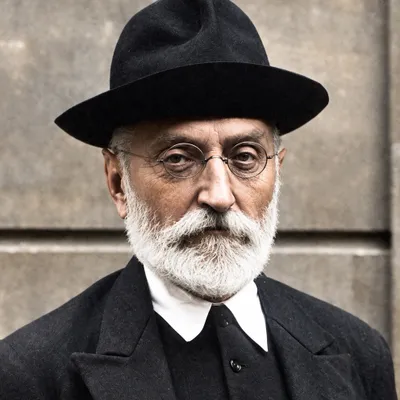
Foreign thinker
Miguel de Unamuno
Miguel de UnamunoExistentialist philosophy and literatureSpanish (Basque)1864–1936
Faith which does not doubt is dead faith.


Life and Thought
Miguel de Unamuno (1864–1936) was a Spanish (Basque) philosopher, novelist, poet, and playwright, and a leading figure of the "Generation of '98" who served for many years as rector of the University of Salamanca. In his central work, The Tragic Sense of Life, he explored the struggle between reason and the human longing for immortality, and between faith and doubt. In 1936, by publicly confronting General Millán-Astray and the fascist slogan "Long live death," he became a symbol of intellectual resistance to tyranny.
Miguel de Unamuno was born on September 29, 1864, in Bilbao, in Spain's Basque Country. He studied philology and classical literature, and from 1891 taught Greek at the University of Salamanca; in 1901 he became rector of the university, a post he would lose and regain more than once.
Under the dictatorship of Primo de Rivera, Unamuno's open opposition led to his dismissal in 1924 and exile to the island of Fuerteventura; after escaping, he spent several years in exile in France, returning to Spain and to the university's rectorship in 1930 following the dictatorship's collapse. In 1936, at the start of the Spanish Civil War, at a university ceremony he publicly denounced the fascist slogan "Long live death" in front of General José Millán-Astray; this defiance led to his house arrest for the remainder of his life. He died on December 31 of that same year.
Unamuno's thought turns on a fundamental tension between "reason" and "faith": through reason, human beings recognize their own mortality, yet they thirst for immortality — an irresolvable conflict he called the "tragic sense of life" (in the book of that title, 1913). He set his concept of agonía — a ceaseless inner struggle — against the false comfort of certainty. In literature, works such as The Life of Don Quixote and Sancho (1905) and innovative novels like Mist (Niebla, 1914), which he termed nivolas, blurred the boundary between the novel and the philosophical essay.
He drew on thinkers such as Søren Kierkegaard and William James, and engaged critically with Nietzsche in his writing. Today Unamuno is regarded as a forerunner of twentieth-century existentialist thought and one of the most important intellectual voices in pre–Civil War Spain.